Hidden biotic stress alters climate sensitivity in woody plants

Hidden biotic stress alters climate sensitivity in woody plants
Moralejo, E.; Montesinos, M.; Landa, B. B.; Olmo, D.
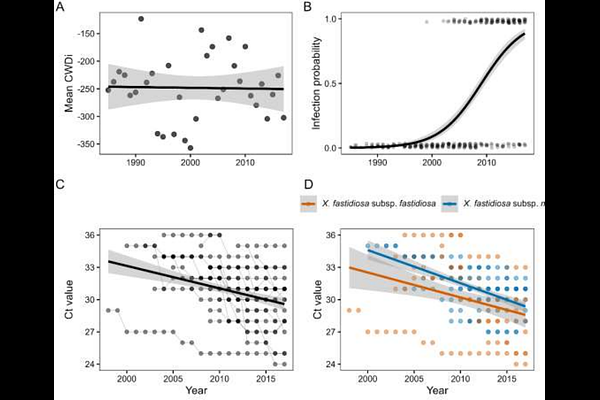
AbstractChronic infection by vascular pathogens is conventionally expected to severely constrain host biomass accumulation, yet empirical evidence from long-lived woody plants remains inconsistent. We investigated the long-term impacts of Xylella fastidiosa colonization on the radial growth and climate sensitivity of adult Mediterranean almond trees (Prunus dulcis), aiming to resolve how persistent vascular infections modulate tree performance and resilience under a changing climate. We coupled high-resolution dendrochronological analysis with a novel, ring-resolved molecular reconstruction of individual infection histories across 706 annual rings. This hindcasting approach allowed for the retrospective identification of precise colonization dates, bacterial loads (Ct values), and pathogen subspecies (subsp. fastidiosa vs. subsp. multiplex). Growth-climate relationships were modelled using standardized ring-width indices (RWI) against a crop-weighted water deficit index (CWDi). Intra-host colonization followed a steep radial gradient, with active bacterial abundance concentrated in newly formed, functional outer xylem. Surprisingly, chronic infection did not trigger a sustained reduction in baseline annual ring width. Instead, pathogens fundamentally reshaped climate-growth sensitivity. Hosts infected by subsp. fastidiosa maintained high plastic growth tracking during wet years, whereas this capacity was significantly attenuated in those harbouring subsp. multiplex. Despite the absence of a chronic signal in trunk radial growth, vascular impairment was tightly associated with severe retrograde canopy dieback. Our findings indicate that chronic infection by X. fastidiosa can act as a latent biotic stressor, altering host physiological sensitivity to environmental fluctuations without directly suppressing baseline stem growth. This pattern is consistent with the marked temporal decoupling between spring cambial activity and late-summer bacterial proliferation, together with progressive vascular dysfunction leading to severe canopy dieback. These results suggest that current abiotic-centred frameworks of drought-induced decline may underestimate the contribution of cryptic vascular pathogens to vegetation mortality under intensifying climate change.