Zinc excess promotes lysosome remodeling by activating HLH-30/TFEB through the action of the high zinc sensor HIZR-1.

Zinc excess promotes lysosome remodeling by activating HLH-30/TFEB through the action of the high zinc sensor HIZR-1.
Cubillas, C.; Liu, H.; Deshmukh, K.; Mendoza, A.; Schneider, D. L.; Herrera, D.; Zhao, C.; Murphy, J. T.; Edwards, J.; Diwan, A.; Kornfeld, K.
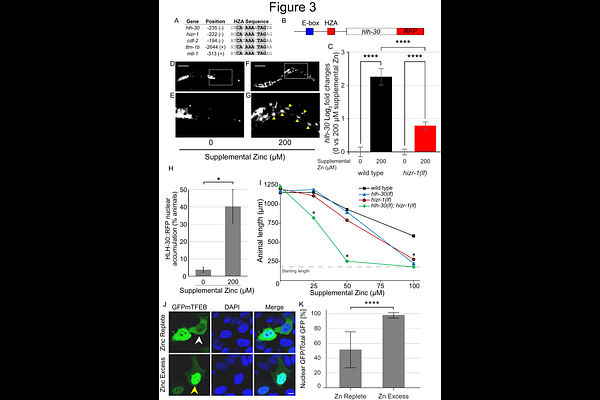
AbstractZinc is an essential element that plays many roles in animals. Since excess zinc is toxic, animals have evolved sophisticated mechanisms to achieve homeostasis. A conserved mechanism is to store excess zinc in specialized lysosomes, which contributes to zinc detoxification and provides a supply when zinc becomes limiting. In C. elegans excess zinc conditions promote an increase in lysosome-related organelles called bilobed granules. Defining how zinc-regulated transcription drives the observed lysosome remodeling is key to understanding zinc homeostasis processes. Here we describe a positively regulated zinc cascade controlled by hizr-1 and hlh-30/TFEB, which encode the C. elegans high zinc sensor and the master regulator of the autophagy-lysosomal pathway, respectively; essential for connecting excess zinc homeostasis to lysosome biogenesis and remodeling. Our transcriptomic, genetic, and bioinformatic studies indicate that hizr-1 and hlh-30 are necessary and sufficient to activate transcription of lysosome genes under excess zinc conditions. In our regulatory model, zinc binding activates HIZR-1 protein, which accumulates in the nucleus and activates genes containing the HZA enhancer, including hlh-30. HLH-30 protein accumulates in the nucleus and activates genes containing the E-box enhancer. Genetic analysis of loss-of-function mutants demonstrated that both hizr-1 and hlh-30 are necessary for animals to tolerate excess zinc. Furthermore, HLH-30 promotes the increase in the number of acidified compartments, whereas HIZR-1 promotes the increase in the volume of the expansion compartment. These results define a genetic pathway that responds to excess zinc by increasing the number of lysosome-related organelles and their capacity to store and detoxify cytosolic zinc.