The abnormal C-terminus in DVL1 impacts Robinow Syndrome phenotypes

The abnormal C-terminus in DVL1 impacts Robinow Syndrome phenotypes
Tophkhane, S. S.; Akarsu, G.; Gignac, S. J.; Fu, K.; Xie, S.; Verheyen, E.; Richman, J.
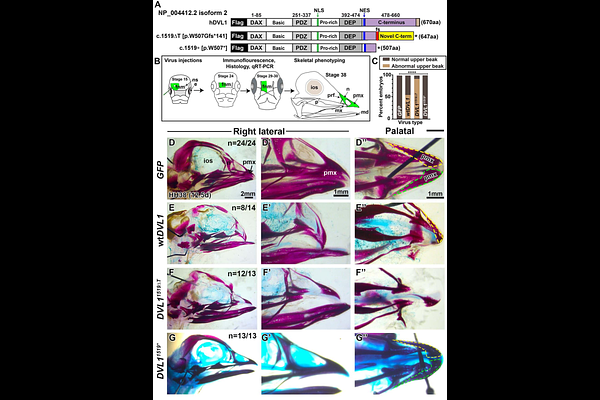
AbstractRobinow Syndrome is a polygenic, rare skeletal disorder characterized by craniofacial and limb defects. The genes involved are in the wingless-related Integration site-1 (WNT) pathway and DVL1 (Dishevelled 1) is the most commonly affected gene. In all pathogenic variants of DVL1, a frameshift replaces the C terminus with a novel peptide. We tested whether the variant DVL11519{Delta}T was sufficient to alter development in vivo and in vitro in two animal models. We compared phenotypes to wtDVL1 or DVL1 with a stop codon at position 1519. Misexpression of DVL11519{Delta}T in the developing face of chicken embryos with an avian retrovirus, leads to a widening of the frontonasal mass similar to the human facial phenotype and ultimately to inhibition of skeletogenesis that was also verified in primary cultures of frontonasal mass mesenchyme. In luciferase assays carried out in facial mesenchyme, the wtDVL1 activated canonical and JNK PCP WNT signalling however the DVL11519* and the DVL11519{Delta}T variant removed some but not all of the signaling activity. We also determined that there is mislocalization of the protein expressed from DVL11519{Delta}T in the nucleus while the other two constructs were mainly found in the cytoplasm. In complementary Drosophila experiments using a variety of readouts, only the DVL11519{Delta}T variant impacted morphogenesis and signaling. This is the first study to clarify the pathogenesis of Robinow syndrome is due to the novel C-terminus of DVL1 which exerts dominant interference on morphogenesis, skeletogenesis and WNT signaling