Nonlinear distributed sensing of light patterns leads to perceptual distortions in plants

Nonlinear distributed sensing of light patterns leads to perceptual distortions in plants
Kempinski, A.; Porat, A.; Riviere, M.; Meroz, Y.
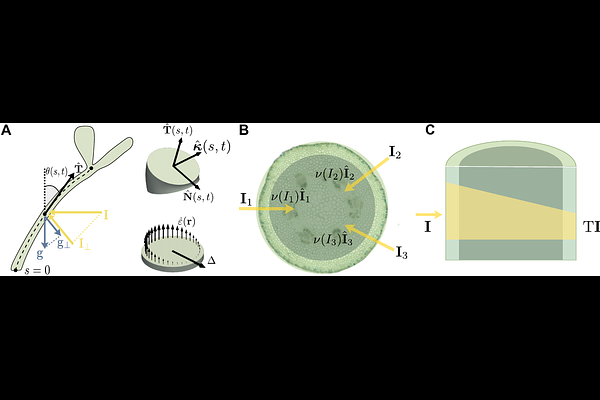
AbstractMany organisms lack centralized sensory-processing systems, navigating complex environments through local integration of spatially distributed stimuli (e.g., chemotaxis of cells, bacteria, or growing neurons). Here we propose the first general physical and geometric framework to describe how such distributed sensing translates into integrated directional responses. We study plants, multicellular decentralized systems that grow towards light (phototropism), which can come from multiple directions and at different intensities. We develop a model in which light is sensed locally on the shoot circumference, transduced nonlinearly, and integrated vectorially; the model is informed and validated by unilateral and bilateral lighting, and out-of-plane illumination experiments on sunflower seedlings. We show that seedlings respond to the vectorial sum of transduced signals rather than to the physical sum of incident light, which can create systematic deviations between maximal physical illumination and growth direction, akin to optical illusions. This framework further predicts that symmetrical, opposing cues cancel each other out, which we validate experimentally using a weaker symmetry-breaking light source.