Human decision-makers terminate evidence accumulation using flexible decision rules

Human decision-makers terminate evidence accumulation using flexible decision rules
Kalburge, I.; Dallstream, A.; Josic, K.; Kilpatrick, Z. P.; Ding, L.; Gold, J. I.
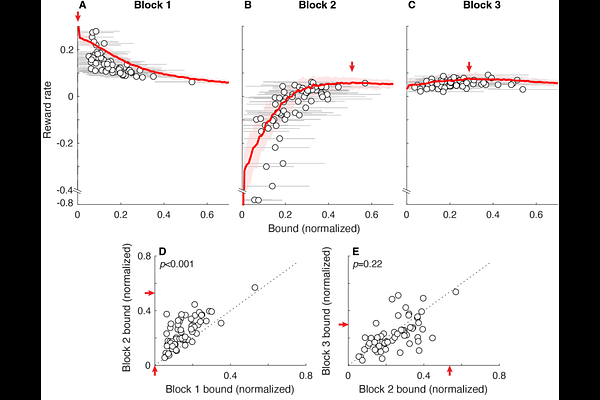
AbstractDecisions based on evidence accumulated over time require rules governing when to end the accumulation process and commit to a choice. These rules control inherent trade-offs between decision speed and accuracy, which require careful balance to maximize quantities that depend on both like reward rate. We previously showed that, to maximize reward rate, normative decision rules adapt to changing task conditions (Barendregt et al., 2022). Here we used a novel task to examine whether and how people use adaptive rules for individual decisions under a variety of conditions, including changes in decision outcomes across trials and changes in evidence quality both across and within trials. We found that the participants tended to use rules that adjusted, at least partially, to predictable changes in task conditions to improve reward rate, consistent with a rationally bounded implementation of normative principles. These findings help inform our understanding of the extent and limits of flexible decision formation in the brain.