Enhancing cGMP signaling with psilocybin reduces head twitch and restructures the synaptic proteome while maintaining antidepressant response

Enhancing cGMP signaling with psilocybin reduces head twitch and restructures the synaptic proteome while maintaining antidepressant response
Floris, G.; Jefferson, S. J.; Rondeau, J.; Menniti, F. S.; Kwan, A. C.; De Aquino, J. P.; Krystal, J. H.; Pittenger, C.; Kaye, A. P.
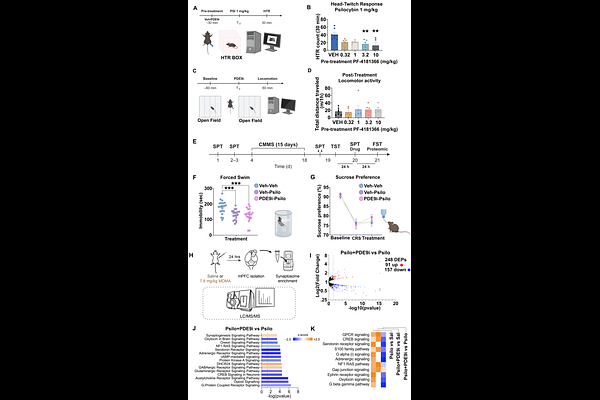
AbstractNew treatments for depression are needed that combine robust efficacy with improved scalability. Although psilocybin has demonstrated antidepressant effects in Phase 3 clinical trials, some of its psychedelic effects limit tolerability, necessitating administration in highly supervised clinical settings, and thus motivating development of serotonergic therapeutics that preserve antidepressant efficacy while reducing the acute psychedelic experience. We combined psilocybin with a phosphodiesterase-9 inhibitor (PDE9i), which raises cyclic GMP levels, and observed substantial reduction in the mouse head twitch response (HTR) -- a proxy for 5-HT2A receptor-mediated psychedelic-like behavior in rodents -- suggesting attenuation of acute psychedelic effects. Significantly, rescue of chronic stress-induced depressive-like behavior by psilocybin was maintained with the coadministration of PDE9i. Proteomic analysis of medial prefrontal cortex (mPFC) synaptosomes showed that the combination of PDE9i and psilocybin enhanced synaptogenesis pathways relative to psilocybin alone, while reducing pathways involved in G protein-coupled receptor (GPCR) signaling. Together, these results suggest that the combination of PDE9i and psilocybin may be a promising direction for psychedelic treatment, and point towards molecular pathways that dissociate acute psychedelic and antidepressant responses.