Quantum Advantage for Sensing Properties of Classical Fields

Quantum Advantage for Sensing Properties of Classical Fields
Jordan Cotler, Daine L. Danielson, Ishaan Kannan
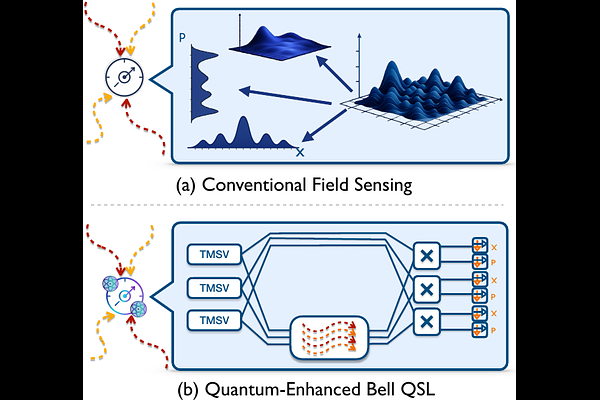
AbstractModern precision experiments often probe unknown classical fields with bosonic sensors in quantum-noise-limited regimes where vacuum fluctuations limit conventional readout. We introduce Quantum Signal Learning (QSL), a sensing framework that extends metrology to a broader property-learning setting, and propose a quantum-enhanced protocol that simultaneously estimates many properties of a classical signal with shot noise suppressed below the vacuum level. Our scheme requires only two-mode squeezing, passive optics, and static homodyne measurements, and enables post-hoc classical estimation of many properties from the same experimental dataset. We prove that our protocol enables a quantum speedup for common classical sensing tasks, including measuring electromagnetic correlations, real-time feedback control of interferometric cavities, and Fourier-domain matched filtering. To establish these separations, we introduce an optimal-transport conditioning method, and show both worst-case exponential separations from all entanglement-free strategies and practical speedups over homodyne and heterodyne baselines. We further show that when squeezing is treated as a resource, a protocol with squeezed light can sense a structured classical background exponentially faster than any coherent classical probe.