Pupil Dynamics Reflect Uncertainty-Driven Adjustments of Probability Learning

Pupil Dynamics Reflect Uncertainty-Driven Adjustments of Probability Learning
Greenhouse-Tucknott, A.; Foucault, C.; Buot, A.; Meyniel, F.
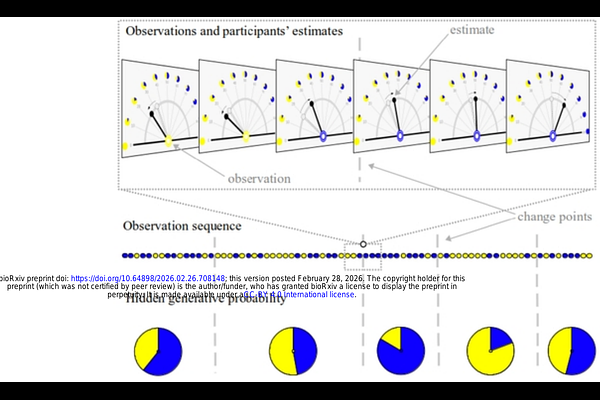
AbstractAdaptive learning in dynamic environments depends on the brains ability to represent and respond to uncertainty. Changes in arousal-mediated pupil diameter provide insight into the neural basis of this process. Prior work has focused on magnitude-based inference tasks, and revealed that learning is primarily influenced by the detection of change points and the corresponding modulation of arousal. In comparison, the role of arousal systems in learning contexts where changes are harder to detect, such as in probability learning, remains poorly understood. Here, we combined pupillometry with a probability learning task in which human participants estimated a hidden generative probability of stimuli that changed abruptly and unpredictably. We adopted a Bayesian ideal observer model to estimate, trial-by-trial, the optimal apparent learning rate and the dynamics of two uncertainty-associated factors - namely, change point probability (the probability that the generative process has abruptly changed) and prior uncertainty (about the current beliefs on this generative process). In line with normative theory, participants heavily relied on prior uncertainty to adjust apparent learning rates. Pupil analyses revealed temporally distinct profiles that separate uncertainty factors: phasic dilations tracked change point probability while tonic pupil dilations tracked prior uncertainty. Mediation analyses further indicated that both phasic and tonic pupil signals at least partially carried the effects of change point probability and prior uncertainty on apparent learning rates, respectively. Together, our results demonstrate that probability learning in a dynamic environment is underpinned by computationally rational integration of latent uncertainty factors, implemented through arousal-associated responses.