Heterozygote Advantage of a Single-Copy SNAP18 Truncation Allele Enables Dominant SCN Resistance and Yield Preservation in Soybean

Heterozygote Advantage of a Single-Copy SNAP18 Truncation Allele Enables Dominant SCN Resistance and Yield Preservation in Soybean
Wang, D.; Han, S.; Chen, L.; Wang, L.; Weng, L.; Yu, H.; Li, C.; Huang, M.; Yang, S.; Feng, X.
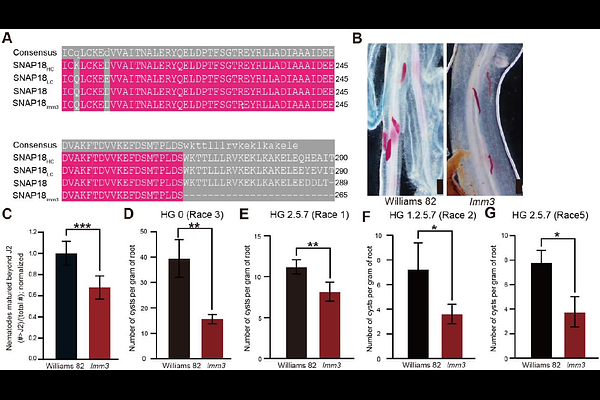
AbstractSoybean cyst nematode (SCN, Heterodera glycines) is the most devastating pathogen threatening global soybean production. The long-term over-reliance on rhg1-a/b resistance has led to the rapid emergence of virulent SCN populations, creating an urgent demand for novel genetic resources to safeguard soybean yield. Here, we identified a rare gain-of-function allele, SNAP18lmm3, via map-based cloning of the lesion-mimic mutant (lmm3) in the SCN-susceptible Williams 82 (rhg1-c) background. This allele encodes a 24-amino-acid C-terminal truncation of SNAP18 and exhibits an unusual mixed dominance genetic profile: the autoimmune-related leaf lesion phenotype is recessive, whereas SCN resistance is dominant. Homozygous lmm3 plants suffer significant yield losses due to spontaneous cell death, but heterozygous (LMM3+/-) plants maintain normal growth, agronomic performance, and seed yield comparable to wild-type Williams 82 in SCN-free field environments. Critically, under artificial SCN inoculation in both field trials and controlled environments, LMM3+/- heterozygotes confer robust resistance, achieving a ~4-fold yield advantage over SCN-infested Williams 82 and a ~44% reduction in cyst formation relative to Williams 82. This resistance profile aligns with the broad-spectrum activity of the lmm3 homozygous mutant, supported by the conserved resistance mechanism of SNAP18lmm3. Transgenic expression of SNAP18lmm3 driven by the nematode-responsive HIP promoter (HIPpro) potently arrested nematode development at the J2 stage in transgenic hairy roots, as evidenced by the drastically reduced proportion of advanced-stage nematodes. Our findings establish SNAP18lmm3 as a potent, "plug-and-play" genetic resource that circumvents the limitations of traditional dosage-dependent resistance loci. This allele enables the development of high-yielding, SCN-resistant soybean cultivars through marker-assisted selection for the heterozygous state or precision genome editing, providing a practical solution for sustainable SCN management.