The central motor command, but not the muscle afferent feedback, is necessary to perceive effort

The central motor command, but not the muscle afferent feedback, is necessary to perceive effort
Pageaux, B.; Bergevin, M.; Angius, L.; Mangin, T.; Lepers, R.; Marcora, S.
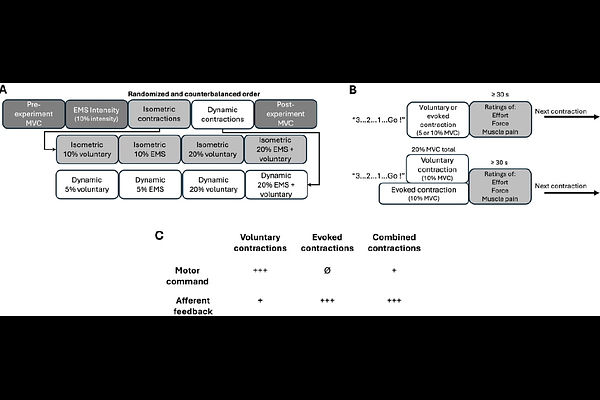
AbstractTwo theoretical models are proposed on the signal processed by the brain to generate the perception of effort (PE): the corollary discharge model and the afferent feedback model. To test the validity of these models, we used electromyostimulation to manipulate the magnitude of the central motor command during voluntary (high motor command), evoked (no motor command) and combined (low motor command) contractions at similar torque outputs. As electromyostimulation evokes sensory volleys to the central nervous system, it was used to evoke muscle contractions and to stimulate afferent feedback. We hypothesized that PE would reflect the magnitude of the central motor command and that evoked muscle contractions in the absence of central motor command would not elicit any PE. Twenty participants (n=10 experienced and n=10 novice with electromyostimulation) volunteered in this study. Participants reported their PE after isometric (10% and 20% MVC) and dynamic (5% and 20% MVC) voluntary, evoked, and combined contractions. For the same torque, participants reported no PE during evoked contractions, but all reported PE during voluntary contractions. Experienced but not novice participants reported lower PE during the combined than during voluntary contractions. This study questions the validity of the afferent feedback model and highlights the key role of motor command-related signals in PE generation. However, results from the novice participants during the combined contractions suggest that other factors such as inhibitory control may affect PE. Future studies should investigate the relationship between the central motor command and PE during physical tasks at various levels of complexity.