Seizure recruitment properties are dependent upon dynamotype: A modeling study

Seizure recruitment properties are dependent upon dynamotype: A modeling study
Karosas, D. M.; Saggio, M.; Stacey, W. C.
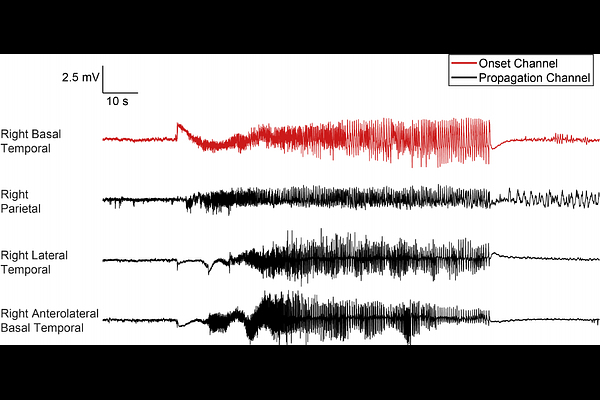
AbstractSeizure propagation - how epileptogenic brain regions recruit less excitable regions - is poorly understood. Previous studies have used dynamical modeling to study seizure propagation and to create patient-specific whole-brain models of seizure spread. However, these studies focused on seizures of a single dynamotype (onset and offset bifurcation pair). Here, we implement a novel coupling method to investigate seizure propagation in a diverse array of dynamotypes. We utilize the Multiclass Epileptor, a recently proposed model that captures a wide range of seizure dynamotypes in a cortical mass ("node"). We consider two nodes: the seizure onset zone (node 1), which bursts autonomously, and the potential propagation zone (node 2), which is not independently epileptogenic but can be recruited by node 1. We examine the impact of intrinsic and coupling factors on the likelihood and speed of recruitment, with particular attention to the onset bifurcation of node 1. We also measure the range of onset behaviors observed in node 2 with respect to the onset behavior of node 1. The model predicted that seizures that display baseline shifts at onset are less likely to spread, and spread more slowly, compared to seizures that do not exhibit baseline shifts at onset. Seizures that present with amplitude scaling at onset were unlikely to propagate. Further, the model predicted the potential for unusual combinations of onset dynamics, such as a baseline shift in node 2 but not node 1. We confirmed the possibility for several of these unusual recruitment behaviors in humans using intracranial electroencephalography data. The results of the study provide a theoretical framework for seizure propagation, establishing a basis for innovations in characterization of patients seizure networks and identification of the seizure onset zone.