Assessment of adult structural plasticity in Drosophila neurons

Assessment of adult structural plasticity in Drosophila neurons
Rodriguez-Caron, M.; Tassara, F. J.; Ispizua, J. I.; Carpio-Romero, C. M.; Ceriani, M. F.
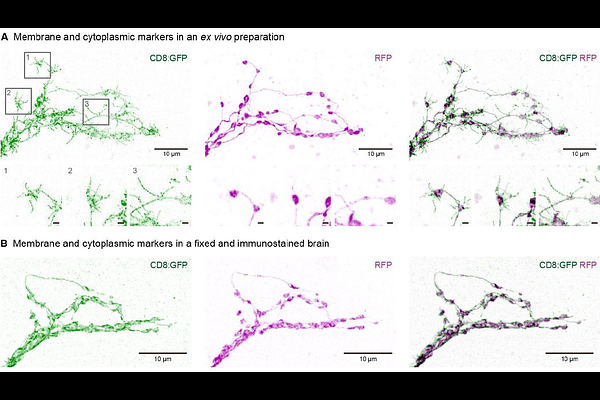
AbstractUnraveling how adult neurons reshape their architecture is key to understanding post-developmental plasticity. Drosophila clock neurons, which remodel their terminals on a daily basis, offer a unique model to examine the mechanisms underlying structural plasticity. In this study, we examine the impact of the experimental design on the remodeling process. We established a simple fixation protocol that preserves tissue integrity and prevents its deformation while enabling the fixation of a larger number of individuals within the appropriate time window. We show that intrinsic (i.e., targeting fluorescent reporters to the membrane) or extrinsic (i.e., temperature) variables may influence this dynamic process. Examining ex vivo preparations, we found that the s-LNv terminals display numerous thin filopodia extending from their synaptic boutons. However, these fine membrane protrusions are lost upon fixation, as they could only be accurately visualized ex vivo. Finally, we present MorphoScope, a Python-based interface that eliminates observer bias in complexity measurements. Altogether, we present a powerful and robust model to investigate the principles of adult neuronal plasticity, with implications extending beyond circadian biology.