TMEM135 deficiency remodels hepatic lipid homeostasis and protein malonylation through a DHA-sensitive lipogenic program buffered by peroxisomal metabolism

TMEM135 deficiency remodels hepatic lipid homeostasis and protein malonylation through a DHA-sensitive lipogenic program buffered by peroxisomal metabolism
Hagimori, R.; Landowski, M.; Song, S.; Gogoi, P.; Brush, R. S.; Bonvicino, S. M.; Barrett-Wilt, G.; Ikeda, S.; Yamada, K.-i.; Yen, C.-L. E.; Takimoto, T.; Agbaga, M.-P.; Ikeda, A.
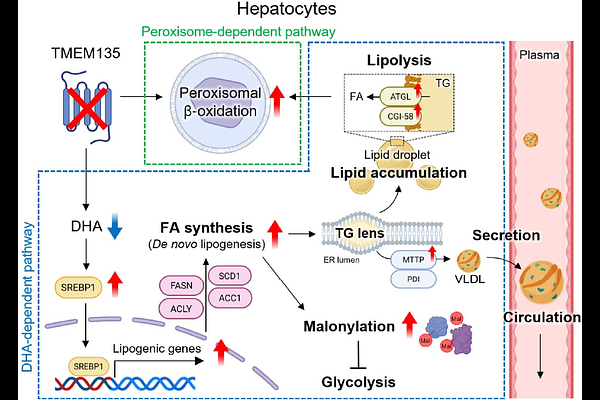
AbstractTMEM135 has been implicated in lipid metabolism, but its role in regulating hepatic lipid homeostasis remains unclear. Here, we investigated how TMEM135 affects hepatic lipid metabolism using Tmem135 mutant mice with liver-specific Pex5 deletion. The Tmem135 mutation induced a lipogenic state characterized by depletion of docosahexaenoic acid (DHA), activation of SREBP-dependent pathways, and increased monounsaturated fatty acids without causing hepatic steatosis. In contrast, loss of PEX5-dependent peroxisomal function in Tmem135 mutant mice resulted in marked hepatic lipid accumulation, indicating that peroxisomal metabolism buffers the elevated lipogenic state. Fish oil supplementation to Tmem135 mutant mice restored DHA levels and suppressed lipogenesis. Proteomics identified distinct DHA-sensitive metabolic programs, including activation of SREBP-dependent lipogenesis. Quantitative malonyl-proteomics revealed increased malonylation of glycolytic enzymes, accompanied by altered glycolytic output. Together, these findings identify TMEM135 as a central regulator of hepatic lipid metabolism and uncover a coordinated mechanism linking lipid availability, lipogenesis, and post-translational metabolic regulation.