Dynamic holocentric genomes facilitate divergent evolutionary paths through chromosomal rearrangements, hybrid dysfunction, and recombination suppression

Dynamic holocentric genomes facilitate divergent evolutionary paths through chromosomal rearrangements, hybrid dysfunction, and recombination suppression
Villegas, R. S.; V. Mohan, A.; Gomez-Ramos, I.; Luceno, M.; Miguez, M.; Maguilla, E.; Corro, J. I. M.; Herrero-Doblado, D.; Sargheini, N.; marques, A.; Lucek, K.; Escudero, M.; Martin-Bravo, S.
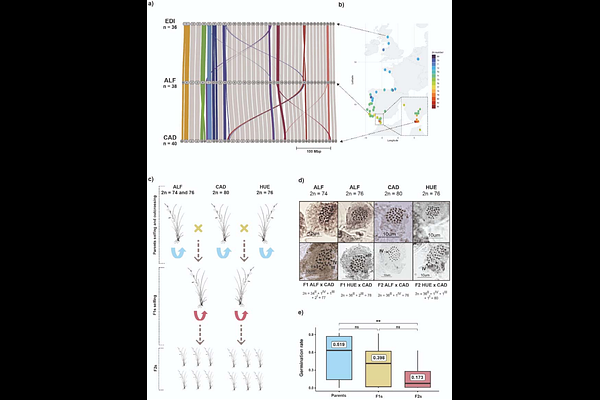
AbstractTheory predicts chromosomal rearrangements (CRs) to promote reproductive isolation and local adaptation by disrupting meiosis and altering recombination landscapes. These processes are especially important in holocentric organisms, whose diffuse centromeres facilitate CRs. Here, we investigated the genomic origins and evolutionary consequences of CRs in the holocentric sedge Carex laevigata, a species with extreme intraspecific chromosome-number variation (2n = 69-84). Establishing chromosome-scale genome assemblies, experimental crosses involving more than one thousand living plants throughout three generations and eight years, linkage mapping, and Quantitative Trait Loci (QTL) analyses, we identified extensive CRs among karyotypically distinct populations. Breakpoint regions of CRs were enriched in GC-rich and repetitive sequences, particularly LTR-Gypsy elements, suggesting recurrent genomic regions prone to structural instability. Inter-cytotype hybrids formed complex meiotic configurations and showed reduced germination success, consistent with hybrid dysfunction associated with increasing chromosomal divergence. Rearranged chromosomes exhibited strong recombination suppression and segregation distortion near breakpoint regions and within inverted segments. QTL analyses further identified fitness-related loci associated with both rearranged and collinear chromosomes. Together, our results corroborate theoretical predictions providing novel empirical evidence that CRs arise preferentially in structurally fragile genomic regions and contribute to genomic divergence through hybrid dysfunction and recombination suppression.