Necroptotic Signalling Diverts Keratinocyte Fate to Promote Differentiation and Slow Wound Healing

Necroptotic Signalling Diverts Keratinocyte Fate to Promote Differentiation and Slow Wound Healing
Anderton, H.; He, Y.; Silke, N.; Lynch-Godrei, A.; Gu, L. H.; Brown, S.; Shimada, K.; Bandala-Sanchez, E.; Cawthorne, W.; Chiou, S.; Hempel, A.; Samson, A. L.; Murphy, J. M.; Silke, J.
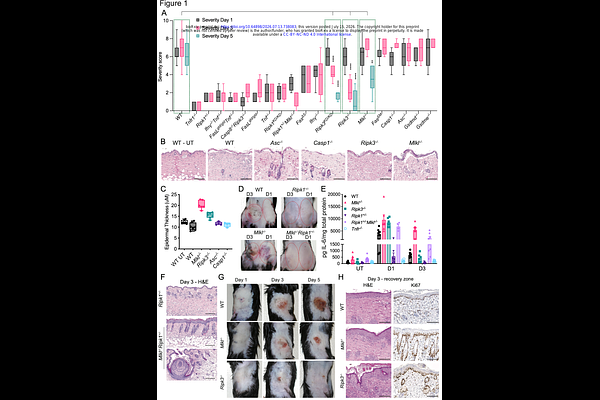
AbstractNecroptosis is best known as a lytic, proinflammatory cell-death pathway mediated by RIPK3 and MLKL. Effective wound repair requires the rapid resolution of inflammation, and ongoing necroptotic activity would only exacerbate tissue damage, delaying healing. However, damaged skin presents a trigger-rich environment for necroptotic signalling, an apparent paradox that remains unresolved. Using genetic ablation and pharmacological inhibition across multiple wound models, we show that inhibiting necroptosis accelerates wound closure, revealing that necroptotic signalling normally restrains repair. Surprisingly, we found that MLKL activation in wild-type keratinocytes induces differentiation and membrane repair rather than cell lysis. This adaptive, non-lethal mode of necroptotic signalling preserves barrier integrity but slows re-epithelialisation. Our findings redefine epidermal necroptotic signalling as a stress-responsive program that modulates keratinocyte fate in a trigger-rich environment. Temporarily dampening this pathway may enhance regeneration after barrier loss without compromising immune defence, revealing necroptosis as a tunable mechanism balancing tissue repair and inflammation.