Tissue composition shapes differential skeletal integration strategies during axolotl limb regeneration

Tissue composition shapes differential skeletal integration strategies during axolotl limb regeneration
Aires, R.; Keeley, S. D.; Brandt, K.; Carreira, M.; Günes, D. B.; Savci, Y.; Friedrich, U. A.; Dahl, A.; Aztekin, C.; Sandoval-Guzman, T.
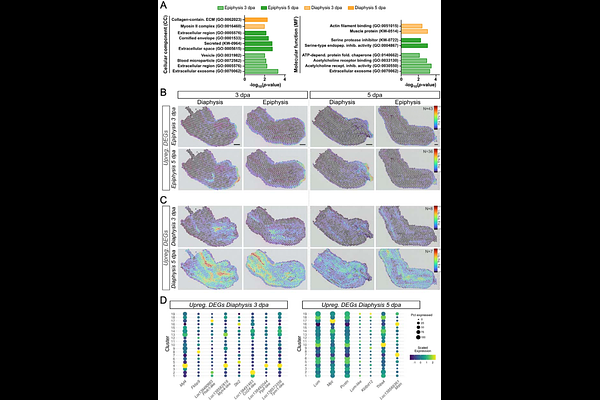
AbstractLimb regeneration requires not only rebuilding the missing structures, but also integrating them with the stump tissues. Osteoclast-mediated tissue resorption is essential for skeletal integration during regeneration. However, given the cellular and structural heterogeneity along the limb skeleton, it is unknown if skeletal tissue composition impacts resorption and, if so, how it is regulated. Here, we show that osteoclast-mediated skeletal resorption is primarily activated in amputations damaging calcified regions of the skeleton, but not in cartilaginous areas. Using a combination of spatial transcriptomics and bulk RNA sequencing, we found that amputations in calcified regions trigger the sustained expression of RANKL and the chemokine Loc138491483/Ccl24-like. We also demonstrate that Loc138491483/Ccl24-like is sufficient to induce osteoclast presence in non-resorbing amputations. Finally, our data suggests that the transcriptomic profile of the apical ectodermal cap is modified according to the underlying tissue types injured by the amputation. Overall, our work reveals that tissue composition at the amputation plane directs important adaptations of the regenerative program to the damaged tissues, particularly regarding integration strategies. These context-dependent responses will ultimately contribute to the near-seamless tissue integration of the regenerating axolotl limb regardless of the amputation position.