Cavity Control of Strongly Correlated Electrons Beyond Resonant Coupling

Cavity Control of Strongly Correlated Electrons Beyond Resonant Coupling
Lukas Grunwald, Xinle Cheng, Emil Viñas Boström, Michael Ruggenthaler, Marios H. Michael, Dante M. Kennes, Angel Rubio
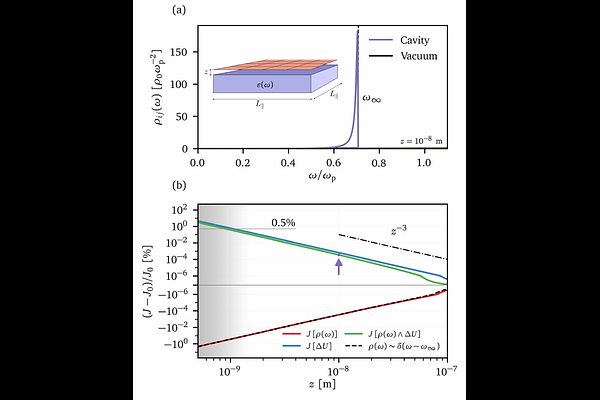
AbstractInterfacing materials with electromagnetic cavities offers a route to modify equilibrium properties through structured vacuum fluctuations. The coupling of light with correlated electrons lacks a characteristic energy scale, making vacuum induced modifications of such systems inherently off-resonant and sensitive to the full photon mode structure. Here, we present a non-perturbative calculation of the cavity induced modification of the magnetic exchange interaction $J$ of the half-filled Hubbard model, including all cavity modes and with parameters determined from first principles. We show that the strength of the modification is controlled by a generalized Purcell factor, proportional to the frequency integrated photonic density of states. This result identifies polaritonic surface cavities as promising platforms to modify correlated systems, while standard Fabry-Pérot resonators produce negligible effects due to spectral weight cancellations upon integration. To perform the calculation, we develop a consistent quantization scheme for materials coupled to a dielectric substrate, in the Coulomb gauge, which reveals a competition between static Coulomb screening and dynamical effects arising from the vector potential. Including both effects is essential to obtain even qualitatively correct predictions. For a gold substrate the light-matter interactions lead to a net enhancement of $J$, whose magnitude is large enough to be observable in two-magnon Raman spectroscopy. Our framework establishes a concrete design principle linking cavity geometry to material response in the off-resonant regime, which will guide future experimental and theoretical explorations.