Chromosome topology gates productive RecA homology search

Chromosome topology gates productive RecA homology search
Tisma, M.; Bhattacharyya, S.; Chang, S.; Ha, T.; Badrinarayanan, A.; Loparo, J.
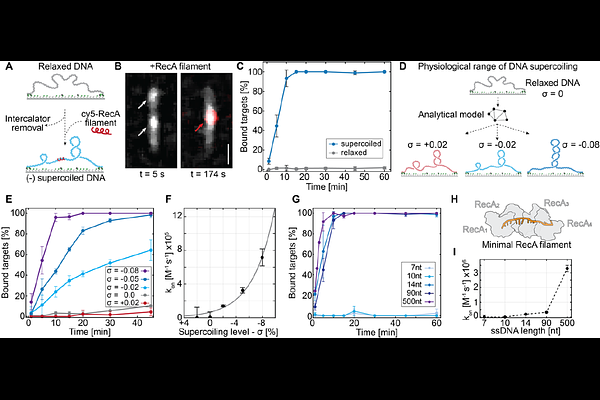
AbstractIn homologous recombination, DNA repair depends on recombinase filaments finding homologous templates on chromosomes whose topology is continually remodeled by replication and transcription. How dynamic chromosome topology affects homology search and DNA repair remains unknown. By combining live-cell imaging of RecA-mediated homology search with single-molecule assays on topologically-defined DNA substrates, we show that DNA supercoiling acts as a selectivity filter for productive homology search. In Caulobacter crescentus cells, supercoiling is dispensable for the filament movement required for homology search, but required for homology target capture and repair. In vitro, filaments transiently sample both relaxed and supercoiled DNA, yet selectively commit to capture only on negatively supercoiled targets. Mechanistically, we find an extreme kinetic preference (~100-fold) of filaments towards negatively supercoiled DNA targets; this topological preference is independent of DNA compaction, pins plectonemes at the capture site, and is conserved across diverse bacterial RecA homologs. Our findings establish that chromosome topology physically regulates homology search and DNA repair.