A Modular, AI-assisted Digitization Toolkit for Resource-Constrained Herbaria: A Case Study from Zimbabwe

A Modular, AI-assisted Digitization Toolkit for Resource-Constrained Herbaria: A Case Study from Zimbabwe
Gatula, L.; Bezrukov, I.; Atemia, J.; Chapano, C.; Gamundani, P. T.; Zimudzi, C.; Chatukuta, P.
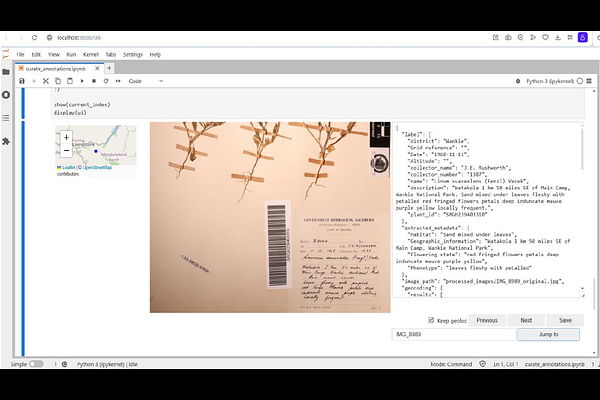
AbstractHerbaria serve as invaluable spatio-temporal repositories of plant diversity information. Digitization of herbarium collections enhances the accessibility, discoverability, and long-term preservation of this important plant information, yet financial and infrastructural constraints often prevent herbaria in resource-constrained regions from digitizing their collections. Consequently, critical plant diversity data gaps remain due to underrepresentation of these collections in global biodiversity databases. Here, we describe an AI-assisted modular digitization toolkit specifically designed for herbaria operating under limited funding, developed and refined through our experience digitizing the crop wild relative (CWR) collection of the National Herbarium of Zimbabwe. The toolkit comprises three core components: (1) a portable, cost-effective photostation assembled from commodity parts, (2) a streamlined cascade workflow for systematic digital imaging, and (3) an AI-assisted data management pipeline for image quality control, label transcription, data analysis, and presentation. Compared to manual transcription and legacy optical character recognition approaches, AI-based transcription achieves lower time cost while maintaining high accuracy, and AI-driven data management delivers accessibility and reduced expenditure relative to conventional database infrastructure. The toolkit is designed to allow herbarium staff full autonomy over the digitization procedure, ensuring institutional ownership and the capacity for independent continuation beyond initial project support. By prioritizing affordability, modularity, and simplicity, this toolkit provides a replicable framework that may enable resource-constrained herbaria to locally generate high-quality scientific data for conservation and the sustainable utilization of plant genetic resources.