Osteopontin promotes lesion repair during Staphylococcus aureus skin infections

Osteopontin promotes lesion repair during Staphylococcus aureus skin infections
Neville, E. E.; Shinohara, M. L.; Zhang, J. Y.; Rathore, A. P. S.; Abraham, S. N.
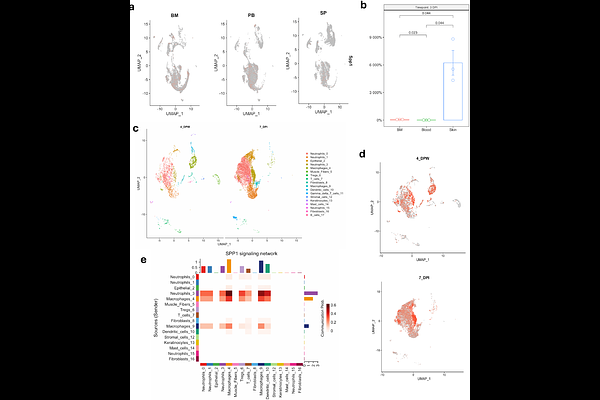
AbstractSkin infections are among the most common types of infections in the United States and pose a serious health threat. Effective resolution requires both bacterial clearance and tissue repair, however the mechanisms underlying tissue repair remain poorly understood. Here, we investigate the cellular responses in a murine model of S. aureus dermonecrotic skin infection using single cell transcriptomics. Within the infected lesions, we identified a major influx of heterogeneous neutrophils, including a distinct subtype expressing high levels of Spp1, the gene encoding osteopontin (OPN). Cell-cell interaction analysis identified Spp1 signaling as the most enriched pathway in infected tissue. In OPN knockout (KO) mice, transcriptomic profiling revealed a lower proportion of fibroblast and keratinocyte cells at the infection site, and a reduction in associated repair signaling pathways. In vivo, OPN KO mice developed significantly larger lesions during skin infection, whereas WT mice treated with recombinant OPN showed accelerated healing relative to untreated controls. Together, these findings highlight the importance of specific neutrophil subtypes and OPN signaling as critical mediators in infected tissue repair. Further our study suggests that modulating OPN may represent a promising therapeutic strategy to accelerate infected tissue repair.