Synthetic analogue of adrenocorticotropic hormone, ACTH(4-7)PGP delays neurological manifestations in diseases of mucopolysaccharidosis III spectrum by reducing neuroinflammation and rescuing neurotransmission, synaptogenesis, and axonal demyelination

Synthetic analogue of adrenocorticotropic hormone, ACTH(4-7)PGP delays neurological manifestations in diseases of mucopolysaccharidosis III spectrum by reducing neuroinflammation and rescuing neurotransmission, synaptogenesis, and axonal demyelination
Moore, T.; Dubot, P.; Viana, G.; Bose, P.; Zhang, E.; Nasseri, B.; Pan, X.; Robertson, D. N.; Feulner, L. M.; Taherzadeh, M.; Van Vliet, P. P.; Bonneil, E.; Khan, S. K.; Zhang, L.; Attanasio, F.; Singamsetty, S.; Durcan, T.; Tomatsu, S.; Thibault, P.; Morales, C. R.; Di Cristo, G.; Andelfinger, G.; Pineyro, G.; Boehm, J.; Lodygensky, G. A.; Wood, J.; Pshezhetsky, A. V.
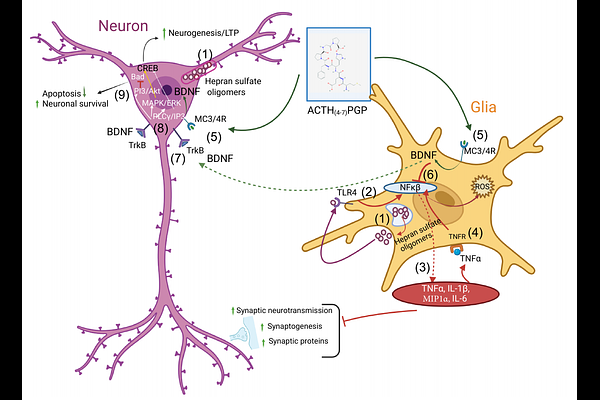
AbstractMucopolysaccharidosis III (MPS III or Sanfilippo disease) is a spectrum of 4 genetic disorders (MPS IIIA-D), caused by defects in the genes SGSH, NAGLU, HGSNAT and GNS encoding enzymes involved in degradation of heparan sulfate (HS). HS accumulates in brain tissues and causes neuronal dysfunction and neurodegeneration leading to neuropsychiatric problems, developmental delays, childhood dementia, blindness and death during the second decade of life. Previously, we demonstrated that pathophysiological mechanisms, underlying MPS IIIC in mouse models, involves functional pathological changes, affecting synaptogenesis and synaptic transmission and leading to learning and memory deficits. These results suggested that a treatment for MPS III could be developed by using compounds inducing synaptogenesis. In the current study, we tested the efficacy of a synthetic peptide ACTH(4-7)PGP, an analog of adrenocorticotropic hormone fragment, previously used as a neuroprotective and anti-inflammatory medication for treatment of acute neurological conditions, including stroke. We show that intranasal administration of ACTH(4-7)PGP restores defective synaptic transmission in CA1 pyramidal neurons of MPS IIIA and MPS IIIC mouse models and rescues the decrease in synaptic proteins in cultured MPS IIIC mouse hippocampal neurons and iPSC-derived neurons of human MPS IIIA, MPS IIIB and MPS IIIC patients. Furthermore, daily intranasal administration of ACTH(4-7)PGP to MPS IIIC and MPS IIIA mice reduces hyperactivity and rescues defects in working and spatial memory, delays progression of CNS pathology including neuroinflammation and axonal demyelination, and increases the lifespan. Together with the absence of any adverse reactions to ACTH(4-7)PGP in the MPS III and WT mice, our results justify testing efficacy of the drug in clinical settings.