Reduced precipitation alters microbial availability and redistribution of rhizosphere carbon

Reduced precipitation alters microbial availability and redistribution of rhizosphere carbon
Zeba, N.; Estera-Molina, K. Y.; Jian, S.; Yan, J.; Chew, A. M.; Blazewicz, S. J.; Nguyen, N. H.; Zhou, J.; Pett-Ridge, J.; Firestone, M. K.; Yuan, M. M.
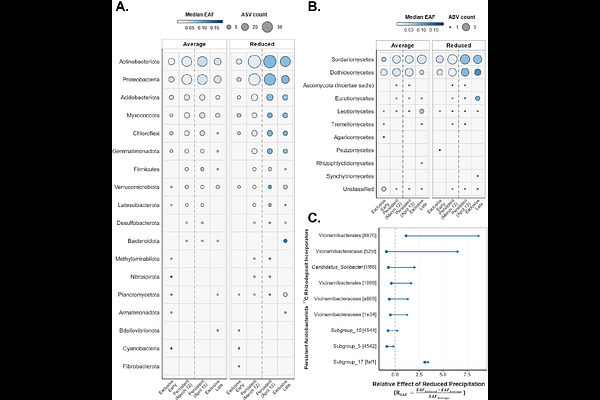
AbstractClimate change intensifies grassland drying, which alters soil carbon storage. Yet, how reduced soil water affects carbon transport and processing in the rhizosphere, a microbial activity hotspot, remains unclear. We traced living root-derived carbon (rhizodeposit C) into soils and microbes using 13CO2 labeling in a multi-year precipitation manipulation experiment in a Mediterranean grassland. With 50% reduced precipitation, soil water content decreased by 20% and soil matric potential was over threefold lower during the growing season, but did not induce signs of plant stress. Modeled solute transport capacity decreased by at least 32%, consistent with reduced rhizodeposit C in the surrounding soil. Up to 59% more rhizosphere microbial taxa actively incorporated rhizodeposit C and showed more associations in 13C-informed co-occurrence networks. Our results suggest that reduced water availability limits rhizodeposit C movement into the surrounding soil and increases spatial isolation among soil microhabitats, increasing the number of rhizosphere microbial consumers and intensifying ecological interactions among them. This is an overlooked mechanism linking precipitation reduction to rhizodeposit C cycling that potentially influences soil organic carbon stability.