A nucleation distance sets the cell size-dependent P-body assembly

A nucleation distance sets the cell size-dependent P-body assembly
Gu, X.; Dexin, S.; Quan, X.; Tsuboi, T.
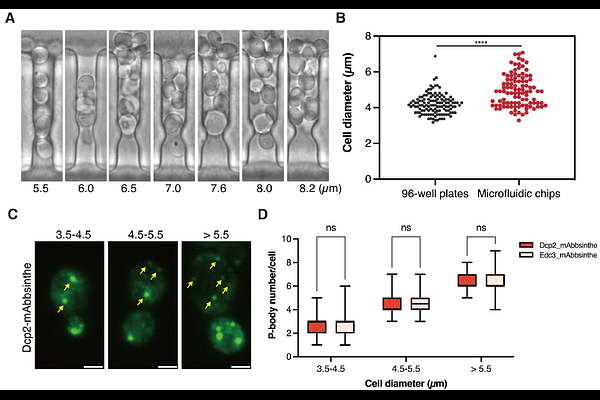
AbstractCells rely on various intracellular structures to regulate biological processes, including phase-separated granules. P-bodies are a type of membrane-less condensate found in eukaryotic cytoplasm that mediate mRNA degradation and storage. While the molecular composition of P-bodies is well studied, the relationship between their spatial organization and cell geometry, particularly cell size and organelle distribution, remains unclear. Here, we developed a conceptual framework to model phase-separation nucleation and validate the nucleation distance of a P-body in living yeast cells. Using microfluidic cell sorting and quantitative fluorescence microscopy, we found that smaller cells contain fewer, larger P-bodies, whereas larger cells form more, smaller granules. Monte Carlo simulations of P-body nucleation accurately recapitulate these cell size-dependent patterns, revealing a nucleation distance of approximately 2.2 micrometers. Furthermore, we demonstrate that increasing vacuolar volume reduces the effective cytoplasmic space and elevates the number of P-bodies, although cell size remains the dominant determinant. Our findings establish nucleation distance as a key parameter that links cell geometry to the biophysical regulation of condensate formation.