A light-labile signal molecule acts as a photoregulator of secondary metabolite biosynthesis in a heterotrophic bacterium

A light-labile signal molecule acts as a photoregulator of secondary metabolite biosynthesis in a heterotrophic bacterium
Dierberger, A.; Rose, M.; Nagel, R.; Jakob, T.; Simpson, C.; Zhang, S.; Hotter, V.; Mittag, M.; Stallforth, P.; Yan, Q.; Sasso, S.
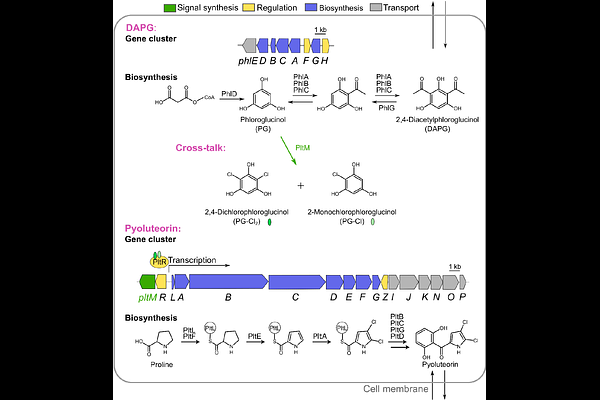
AbstractWhile light is essential for many phototrophic organisms, our knowledge of the light-dependent regulation in heterotrophic organisms is scarce. Here, we found that the heterotrophic soil bacterium Pseudomonas protegens differentially accumulated 234 secreted metabolites depending on the light conditions. These metabolites included important antimicrobials such as pyoluteorin, 2,4-diacetylphloroglucinol, pyrrolnitrin, and rhizoxin analogs. Pyoluteorin, for instance, was 140-fold more abundant in the dark, due to a strong upregulation of the transcript of the pyoluteorin biosynthesis gene pltL . We discovered that 2,4-dichlorophloroglucinol (PG-Cl2), an activator of pyoluteorin biosynthesis, acts as a photoregulator that degrades much faster in the presence of light than in the dark. The resulting higher PG-Cl2 levels activate the pltL promoter in the dark. These findings reveal a novel mode of regulation in which light instability of a signal molecule allows the producing organism to sense and transmit light information to regulate the biosynthesis of a secondary metabolite.