Probing (sub-)solar-mass black holes and superspinars with current and next-generation gravitational-wave observatories

Probing (sub-)solar-mass black holes and superspinars with current and next-generation gravitational-wave observatories
K. S. Sruthy, N. V. Krishnendu, Chandrachur Chakraborty, Nami Uchikata
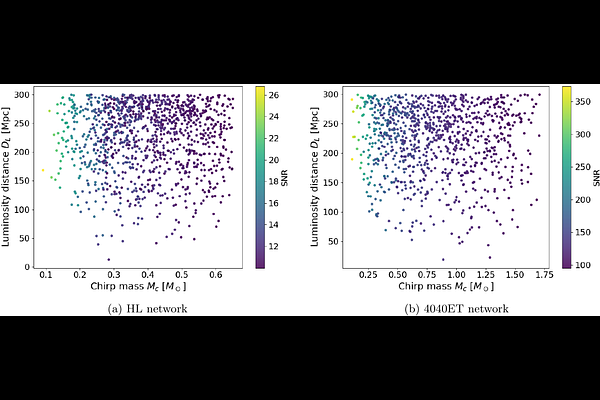
AbstractGravitational-wave observations provide a powerful probe of compact objects and strong-field gravity. In this work, we investigate the detectability of binaries containing (sub-)solar-mass black holes and superspinars with current and next-generation gravitational-wave observatories. Such objects may arise from primordial formation channels or from more exotic high-energy scenarios, and their detection would provide important insights into the population of low-mass compact objects and the physics of extreme gravitational fields. We model the gravitational-wave signals using the frequency-domain post-Newtonian inspiral waveform model TaylorF2, and truncate the signal at the innermost stable circular orbit (ISCO) to avoid contamination from the post-inspiral regime. We assess the observability of these systems using the sensitivities of current detectors such as Advanced LIGO and upcoming third-generation observatories including the Einstein Telescope and Cosmic Explorer. Our results show that while current detectors have limited reach for very low-mass binaries, third-generation observatories can enhance both detection capability and parameter-estimation precision. Their improved strain sensitivity and extended low-frequency coverage allow these observatories to track the inspiral phase over a substantially larger number of gravitational-wave cycles. As a result, they achieve considerably higher signal-to-noise ratios and provide dramatically improved constraints on binary parameters. In particular, it is possible to measure the primary spin parameter with precision $Δχ_{1z}~\sim~10^{-4}-10^{-3}$, potentially allowing clear observational discrimination between near-extremal black holes and superspinars in the mass range $0.1~M_\odot-2~M_\odot$ and with signal-to-noise ratio of $\sim 100-350$.