Seasonal Human Coronaviruses OC43, 229E, and NL63 Induce Cell Surface Modulation of Entry Receptors and Display Host Cell-Specific Viral Replication Kinetics

Seasonal Human Coronaviruses OC43, 229E, and NL63 Induce Cell Surface Modulation of Entry Receptors and Display Host Cell-Specific Viral Replication Kinetics
Siragam, V.; Maltseva, M.; Castonguay, N.; Galipeau, Y.; Srinivasan, M. M.; Soto, J. H.; Dankar, S.; Langlois, M.-A.
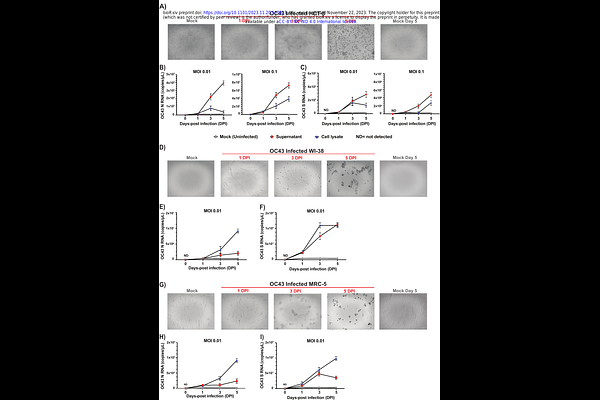
AbstractThe emergence of the COVID-19 pandemic prompted increased interest in seasonal human coronaviruses. 229E, OC43, NL63 and HKU1 are endemic seasonal coronaviruses that cause the common cold and are associated with generally mild respiratory symptoms. In this study, we identified cell lines that exhibited cytopathic effects (CPE) upon infection by three of these coronaviruses and characterized their viral replication kinetics and the effect of infection on host surface receptor expression. We found that NL63 produced CPE in LLC-MK2 cells, while OC43 produced CPE in MRC-5, HCT-8 and WI-38 cell lines, while 229E produced CPE in MRC-5 and WI-38 by day 3 post-infection. We observed a sharp increase in nucleocapsid and spike viral RNA (vRNA) from day 3 to day 5 post-infection for all viruses, however the abundance and the proportion of vRNAs copies measured in the supernatants and cell lysates of infected cells varied considerably depending on the virus-host cell pair. Importantly, we observed modulation of coronavirus entry and attachment receptors upon infection. Infection with 229E and OC43 led to a downregulation of CD13 and GD3, respectively. In contrast, infection with NL63, and also with OC43, lead to an increase in ACE2 expression. Attempts to block entry of NL63 using either soluble ACE2 or anti-ACE2 monoclonal antibodies demonstrated the potential of these strategies to greatly reduce infection. Overall, our results enable a better understanding of seasonal coronaviruses infection kinetics in permissive cell lines, and reveal entry receptor modulation that may have implications in facilitating co-infections with multiple coronaviruses in humans.