Speed Synchrony Promotes Collective Motion in Mixed-Species Fish Schools

Speed Synchrony Promotes Collective Motion in Mixed-Species Fish Schools
Tiwari, J.; Nabeel, A.; Torsekar, V. R.; Dhar, J.; Lamshana, F.; Guttal, V.
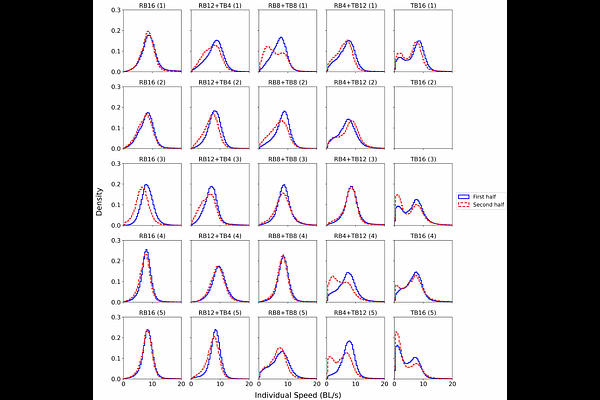
AbstractPrinciples of collective motion are now well established, though research has largely focused on homogeneous groups. Heterogeneity is widespread in animal groups, e.g. arising from sex, size or even species, raising a central question: can collective behaviour emerge when individuals have distinct behaviours? Here, we combine experiments and modelling to investigate mixed-species collective motion using two closely related fish species, rosy barbs and tiger barbs. In conspecific groups, both species exhibit collective motion, but they differ strikingly in their intrinsic movement: tiger barbs exhibit slow- and fast-swimming, whereas rosy barbs display fast swimming only. Despite this difference, these species readily form mixed-species schools where the slow swimming speed of tiger barbs disappears, and the collective motion is dominated by a single fast-swimming mode. We develop an individual-based model incorporating local interactions involving speed matching. Our model demonstrates that bimodal speed in conspecific schools of tiger barbs is an emergent property that is lost in mixed-species groups. Additionally, despite high cohesion, we observe spatial sorting of the two species within the mixed-species groups, which our model explains through differences in inter- and intra-specific interactions. Our results provide experimental evidence that canonical principles of collective motion extend to heterogeneous mixed-species groups.