Snap Back to Reality: The Comparison of Spatial Memory in the Lab and the Real World

Snap Back to Reality: The Comparison of Spatial Memory in the Lab and the Real World
Huffman, D. J.; Annes, P. J.; Gowda, C.; Colina, L.
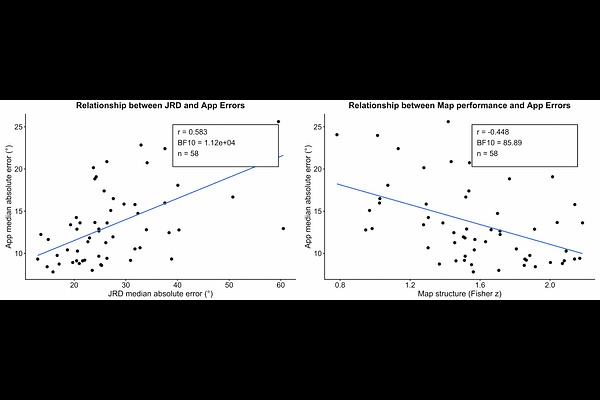
AbstractSpatial navigation could theoretically serve as an early neurobehavioral marker of Alzheimer's disease risk, yet technological limitations have hindered its widespread adoption. We leveraged breakthroughs in technology to create a custom smartphone application to compare real-world spatial memory with lab-based measures. Specifically, we compared performance across two established lab-based tasks, judgments of relative direction (JRD) and map drawing, and our novel app-based, in situ pointing task administered in a familiar large-scale, real-world environment. Young adults completed both laboratory and mobile navigation tasks, allowing within-subject comparisons across modalities. JRD performance strongly correlated with map drawing performance. In contrast, App-based pointing showed lower error and reduced inter-individual variability relative to JRD performance, but weak correlations with lab-based measures. We also developed a novel analytical technique in which we transformed the app-based pointing into a relational, JRD-like metric, and we observed strong correlations and correlated patterns of errors across all tasks. Thus, real-world, app-based pointing captures stable directional performance (e.g., as indexed by the lower errors and lower variability relative to the JRD Task) and, when expressed in a common framework, correlates with laboratory measures of spatial memory, thus suggesting that these tasks tap into partially overlapping cognitive representations. These results provide a pivotal advancement to our understanding of both shared and unique variance across spatial memory paradigms, and support the use and further development of mobile navigation tools as scalable complements to lab-based assessments for studying spatial cognition and its decline in preclinical and clinical stages of Alzheimer's disease.