USP18-STAT2 axis enhances hepatic resilience under proteotoxic stress

USP18-STAT2 axis enhances hepatic resilience under proteotoxic stress
Sen, A.; CHOWDHURY, S.; Chakrabarti, P.
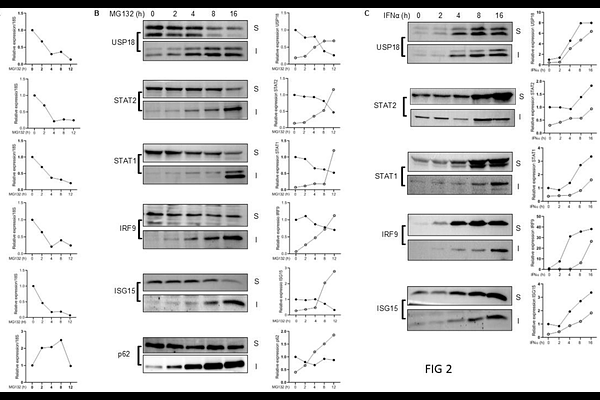
AbstractThe liver is a metabolic hub with a high protein turnover that renders it uniquely susceptible to proteotoxic stress. Perturbation of proteostasis, either by proteasomal inhibitors or in chronic liver diseases, could adversely impact liver physiology. Here, we show that proteasomal inhibition unexpectedly suppresses basal type I interferon (IFN I) signaling in the murine liver. Proteasomal inhibition by bortezomib selectively downregulates a subset of interferon-stimulated genes (ISGs), among which USP18 and ISG15 emerge as critical determinants of hepatocellular survival. We identify USP18 as a central cytoprotective factor that prevents proteotoxic apoptosis independently of its deubiquitinase activity, but strictly requires its scaffolding function mediated by isoleucine-60 and interaction with STAT2. Mechanistically, proteotoxic stress disrupts IRF9 nuclear translocation, attenuating USP18 transcription, and drives USP18 and other ISGs into insoluble aggregates with kinetics distinct from canonical IFN I induced insolubility. Strikingly, IFN alpha priming preserves ISG solubility, restores USP18 abundance, and confers resistance to proteotoxic cell death. Together, these findings uncover an unanticipated link between proteostasis and innate immune signaling, and establish the USP18-STAT2 axis to enhance hepatic resilience under proteotoxic stress.