Lactic acid influences iron assimilation by a fungal pathogen via the iron reductive uptake pathway

Lactic acid influences iron assimilation by a fungal pathogen via the iron reductive uptake pathway
Gomes-Goncalves, A.; Van Genechten, W.; Ataide, P.; Barata Antunes, C.; Ghasemi, F.; Casal, M.; Teixeira, M. C.; Arino, J.; Brown, A. J. P.; Van Dijck, P.; Paiva, S.
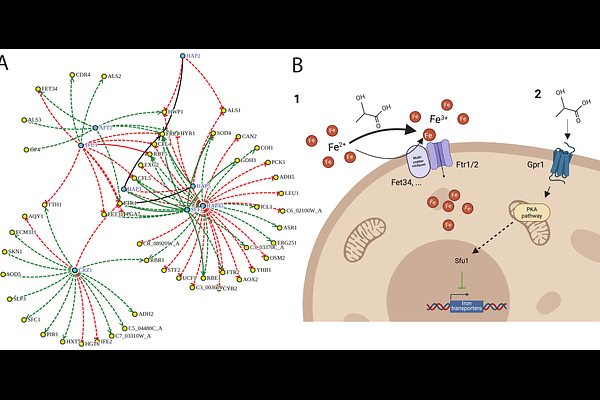
AbstractCandida albicans is a fungal commensal of humans that often causes mucosal infections in otherwise healthy individuals, and also serious infections in immunocompromised patients. The capacity of this fungus to colonise and cause disease relies on its ability to grow within the host, adapting to various nutrient restrictions and physicochemical conditions. The presence of alternative carbon sources, such as the lactate produced by the local microbiota, influences C. albicans antifungal drug resistance and immune evasion. In this study, we used genome-wide transcriptomic analysis to investigate the effect of lactate exposure upon metabolic rewiring. We provide evidence that C. albicans cells respond to growth in the presence of lactate at pH 5 by regulating genes encoding micronutrient transporters, notably iron transporters. More specifically, lactate triggers the downregulation of genes on the reductive iron uptake pathway, inferring a diminished requirement for high-affinity iron uptake. This is supported by the observation that lactate promotes the intracellular accumulation of iron by C. albicans cells. Lactate even enhances the growth of iron-transport defective C. albicans cells under iron-limited conditions. Lactate is known to activate protein kinase A (PKA) signalling. However, lactate-induced iron assimilation is PKA-independent. This work provides new insights into the role of lactate in iron homeostasis - two important factors that promote C. albicans virulence in the mammalian host, where nutritional immunity is a key antimicrobial strategy.