An AI-Native Biofoundry for Autonomous Enzyme Engineering: Integrating Active Learning with Automated Experimentation

An AI-Native Biofoundry for Autonomous Enzyme Engineering: Integrating Active Learning with Automated Experimentation
Zhang, C.; Yang, L.; Qin, Y.; Li, D.; Dong, S.; Yang, M.
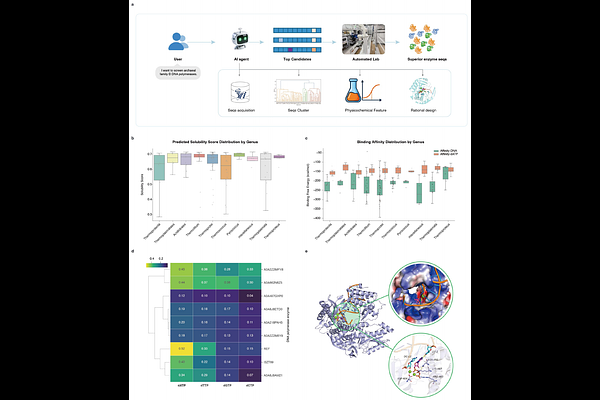
AbstractThe engineering of enzymes with novel functions is a cornerstone of synthetic biology but remains bottlenecked by the fragmentation between computational design and physical execution. While "self-driving" laboratories promise to resolve this, existing systems often rely on rigid, device-specific scripts that lack the flexibility to handle complex, evolving scientific tasks. Here, we report an AI-native autonomous biofoundry that fundamentally redefines laboratory automation through a "cloud-edge synergistic" architecture. The platform features an Agent-Native control system powered by Large Language Models (LLMs) and the Model Context Protocol (MCP), which bridges the semantic gap between abstract scientific intent and heterogeneous hardware execution. This architecture enables non-experts to orchestrate the entire Design-Build-Test-Learn (DBTL) cycle via natural language. By integrating deep phylogenetic mining, zero-shot protein language models (ESM-2), and supervised active learning, our system efficiently navigates rugged fitness landscapes. As a rigorous proof of concept, we applied this platform to evolve a Family B DNA polymerase for CoolMPS sequencing, a task requiring the incorporation of non-natural 3'-blocked nucleotides. In just three autonomous rounds, the platform achieved a hit rate of >66% and identified variants with a 37% reduction in sequencing error rate compared to a commercial reference. This work demonstrates that AI-native infrastructures can not only accelerate trait evolution by orders of magnitude but also provide a scalable, brand-agnostic paradigm for the future of automated scientific discovery.