Toxoplasma GRA8 engages the host ESCRT accessory protein ALG-2 and is necessary for parasite metabolic integrity

Toxoplasma GRA8 engages the host ESCRT accessory protein ALG-2 and is necessary for parasite metabolic integrity
Kaur, H.; Guevara, R. B.; Rivera-Cuevas, Y.; Olafsson, E. B.; Mayoral, J.; Augusto, L.; Guerra, A. J.; Patel, R.; Bohannon, K. P.; Sexton, J. Z.; Hanson, P. I.; Weiss, L. M.; Carruthers, V. B.
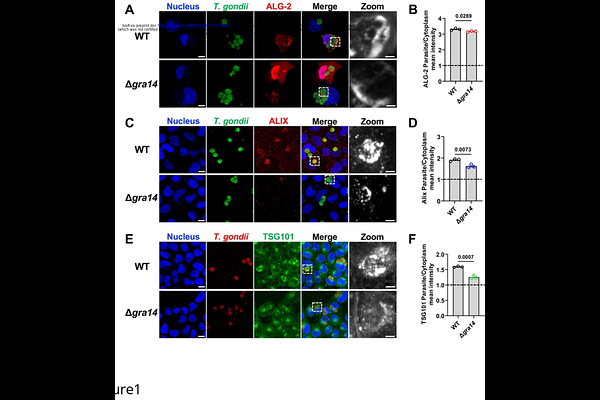
AbstractThe endosomal sorting complex required for transport (ESCRT) is a hetero-multimeric membrane-remodeling machinery essential for endosomal sorting, intraluminal vesicle formation, cytokinetic abscission, and membrane repair. ESCRT is also hijacked by some pathogens including the protozoan Toxoplasma gondii, which subverts it at the parasitophorous vacuole membrane to support parasite ingestion of host cytosolic proteins. Although the ESCRT accessory protein, ALG-2 is recruited to the parasitophorous vacuole, nothing was known about how this happens. Herein we identify the dense granule protein TgGRA8 as a key effector that recruits ALG-2 and ALIX to the parasitophorous vacuole. We show that TgGRA8 directly binds ALG-2 via conserved ALG-2-binding elements like those found in other ALG-2 interacting proteins including ALIX and SEC31A. Biochemical assays show high-affinity, Ca2+-dependent TgGRA8-ALG-2 binding, and structural modeling suggests TgGRA8 may assemble multivalently to coordinate multiple ALG-2 dimers, stabilizing ALG-2/ALIX recruitment through a non-canonical bridging mechanism. Conservation of these motifs among tissue cyst-forming coccidians implies a lineage-linked adaptation that supports infection by these parasites. Metabolomics further indicates that TgGRA8 loss disrupts amino acid, purine, and central carbon metabolism, like those seen in other ingestion deficient mutants. Together, these findings uncover a conserved, multivalent strategy by which Toxoplasmaengages host ALG-2 to organize ESCRT at the parasitophorous vacuole, thereby coupling nutrient acquisition to metabolic fitness and exposing a novel agent for probing ESCRT biology.