Environmental history shapes host-associated dynamics of sporulating and non-sporulating bacterial subpopulations during infection

Environmental history shapes host-associated dynamics of sporulating and non-sporulating bacterial subpopulations during infection
Toukabri, H.; Buisson, C.; Le Vern, Y.; Sausset, A.; Bourge, M.; Slamti, L.
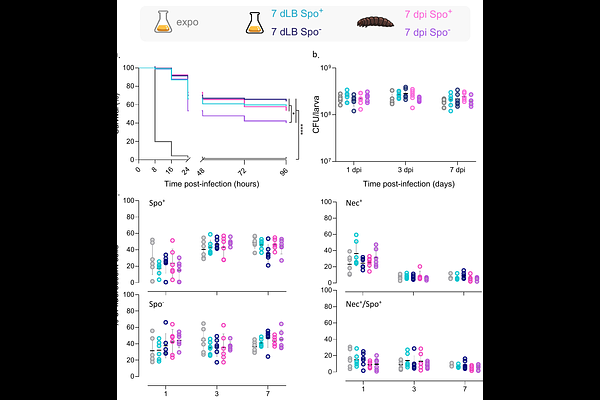
AbstractHost-associated environments represent ecological contexts that can structure microbial population dynamics, yet their effects on sporulating pathogens remain poorly understood. We investigated how passage through a natural insect host shapes population-level traits in the entomopathogen Bacillus thuringiensis. Using Galleria mellonella larvae, we compared the characteristics of bacterial populations extracted from insect cadavers with those maintained under in vitro conditions. Passage through the host generated a distinct population structure, characterized by the stable coexistence of sporulating and non-sporulating bacteria and a larger non-sporulating fraction than in in vitro cultures. Host-extracted bacteria exhibited a different morphology and higher virulence than in vitro-grown populations, the latter being largely due to the non-sporulating fraction of the population, as shown by reinfection experiments with each subpopulation isolated via fluorescence-activated cell sorting. On the other hand, all subpopulations persisted similarly in the host and completed the infection cycle. Host-extracted subpopulations also showed increased tolerance to oxidative stress, consistent with an adaptation to conditions encountered within insect cadavers. Furthermore, competition assays revealed that non-sporulating bacteria from insect cadavers outcompeted sporulating cells, whereas the opposite was observed for in vitro-grown bacteria. In addition, spores produced in the host displayed reduced heat resistance but germinated more efficiently than laboratory-derived spores, highlighting environment-dependent properties which may affect transmission potential. Together, these results demonstrate that the host-associated ecological context drives functional differentiation within bacterial populations and modulates key traits linked to survival, competition, stress tolerance and persistence, emphasizing the importance of host-associated environments in structuring ecological properties of sporulating pathogens.