Single-Cell Proteomics Reveals Heterogeneous and Bimodal Proteome Responses to DNA Damage

Single-Cell Proteomics Reveals Heterogeneous and Bimodal Proteome Responses to DNA Damage
Adoni, K. R.; Charlton, G. H.; Ditcham, J. E.; Cook, D. T.; Ho, J.; Kirkpatrick, J.; Zenezini Chiozzi, R.; Thalassinos, K.
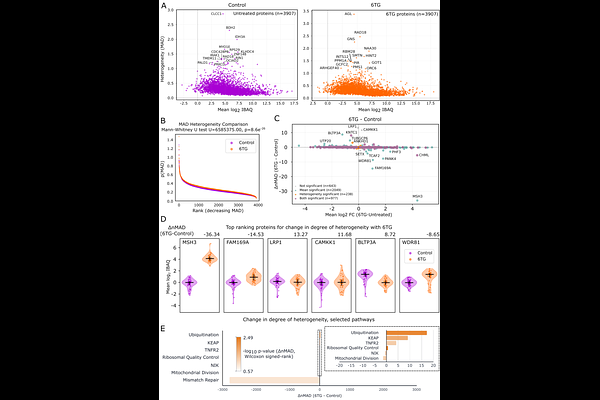
AbstractDNA damage response (DDR) involves coordinated activation of repair, checkpoint, and stress adaptive signalling pathways following genomic toxicity. Bulk-cell proteomics, however, averages divergent responses across neighbouring cells, obscuring the characterisation of biologically meaningful proteome remodelling during genotoxic stress. This is particularly relevant to DDR, where a subset of cells undergo apoptosis, resulting in the sampling of dead cells that confound downstream biological interpretation. Here, we applied single cell proteomics (SCP) to investigate the proteome response of U-2 OS cells to 6-thioguanine (6TG)-induced DNA damage. By filtering individual cells according to predefined morphological-, sampling- and biological-criteria, to ensure a matched comparison between control and DNA-damaged populations; 6TG treatment was found to activate canonical DDR, including mismatch repair and base excision repair, together with secondary stress responses linked to oxidative stress, mitochondrial dysfunction, inflammatory signalling and proteostasis. Using SCP, we were able to probe neighbouring cell-to-cell heterogeneity, revealing globally increased protein abundance variability following DNA-damage. Importantly, mismatch repair protein MSH3 exhibited amongst the largest abundance increases, concomitant with the greatest reduction in cell-to-cell abundance heterogeneity across all quantified proteins, highlighting it as the most robust and reproducible respond-er to 6TG-induced DNA damage. Furthermore, analysis of protein-abundance heterogeneity revealed proteins that exhibit bifurcated abundance states across neighbouring cells, with DNA damage inducing either the emergence or loss of these bimodal abundance distributions. Proteins linked to gene expression and protein synthesis were driven towards bifurcation into discrete high-low protein abundance states across neighbouring cells following DNA-damage. Conversely, 6TG abolished the intrinsic high-low abundance bimodality of several core-signalling, stress-signalling and trafficking proteins, suggesting their coordinated homogenisation in response to genotoxic stress. Collectively, these findings demonstrate the power of SCP to resolve the coordinated, yet heterogeneous, cellular response to DNA damage within a population of genetically identical cells.