The Phase Quantum Walk: A Unified Framework for Graph State Distribution in Quantum Networks

The Phase Quantum Walk: A Unified Framework for Graph State Distribution in Quantum Networks
Soumyojyoti Dutta
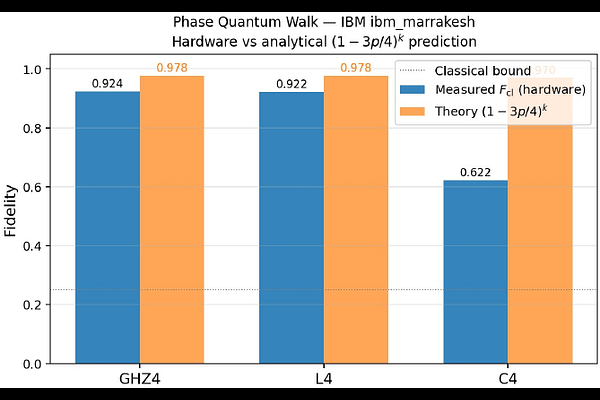
AbstractDistributing arbitrary graph states across quantum networks is a central challenge for modular quantum computing and measurement-based quantum communication. I introduce the phase quantum walk (PQW), a discrete-time quantum walk in which the conventional position-permuting shift operator is replaced by a diagonal conditional phase (CZ) gate, enabling distribution of arbitrary graph states, not merely GHZ states, from elementary two-qubit resources. The Byproduct Lemma shows that each walk step teleports edge entanglement with a correctable Pauli byproduct; the Coin Invariance Theorem proves that the optimal fidelity F*(C,E) = F*(H,E) for all unitary coins C and noise channels E, with closed-form expressions F_dep = (1 - 3p/4)^k and F_pd = ((1 + sqrt(1 - p))/2)^k. Analytical correction formulas are derived for tree graphs (general theorem) and ring graphs (C4 case study), with F = 1.0 verified across eight topologies (up to 4096 outcomes). Hardware validation on ibm marrakesh (IBM Heron r2, CZ-native) yields F_cl = 0.924 for |GHZ4> and 0.922 for |L4>, statistically identical, providing the first experimental confirmation that fidelity is independent of graph topology as predicted by the Coin Invariance Theorem.