Massive-scale single-nucleus multi-omics identifies novel rare noncoding drivers of Parkinson's disease

Massive-scale single-nucleus multi-omics identifies novel rare noncoding drivers of Parkinson's disease
Menon, S.; Turner, A. W.; Chang, S. H.; Johnson, A. W.; Chang, H. H.; Shah, A. J.; Zeng, Y.; Strohlein, C. E.; Kampman, L.; Colston, C.; Kozlenkov, A.; Dracheva, S.; Avenali, M.; Palermo, G.; Ceravolo, R.; Valente, E. M.; Gabbert, C.; Trinh, J.; Serrano, G. E.; Beach, T. G.; Global Parkinson's Genetic Program (GP2), ; Shulman, J. M.; Blauwendraat, C.; Montine, T. J.; Fang, Z.-H.; Belloy, M. E.; Corces, M. R.
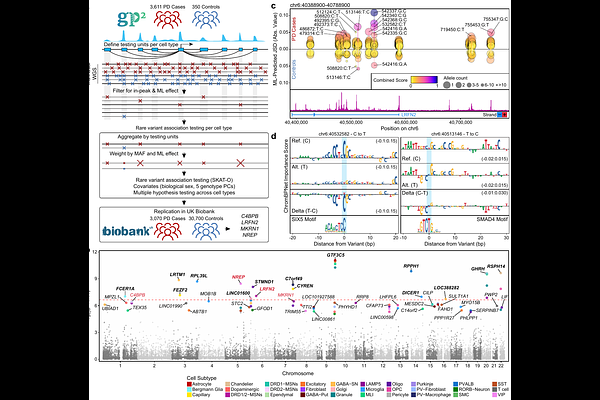
AbstractMost genetic variants contributing to complex diseases reside in the noncoding genome. While common variants uncovered by genome-wide association studies often fail to explain much of the observed heritability of these diseases, rare variants often have higher effect sizes and cumulatively explain a larger portion of heritability. However, rare variants, particularly rare noncoding variants, have remained under-characterized largely due to the difficulties of accurately predicting variant functionality at scale, given that each individual carries an average of ~10,000 rare variants. Here, we generated multi-omic data from >3.3 million nuclei sampled from five brain regions across a cohort of 80 individuals with Parkinson's disease (PD) and 21 neurologically normal control individuals with matched 30x whole-genome sequencing. We use this data to identify cell type-specific features of PD, map cell type-specific chromatin accessibility and expression quantitative trait loci, and train machine learning models to predict the effect of variants on gene regulation. We identify rare noncoding variants statistically associated with sporadic PD and extend our approaches to predict drivers of familial PD of unknown genetic origin. Our results underscore the significance of rare noncoding variants in complex diseases and provide a roadmap for applying similar approaches in other disease systems.