Structural principles of transcriptional collisions

Structural principles of transcriptional collisions
Watters, J. W.; Mueller, A. U.; Ju, X.; Chuquimarca, S. J.; Ye, H. J.; Darst, S. A.; Alushin, G. M.; Liu, S.
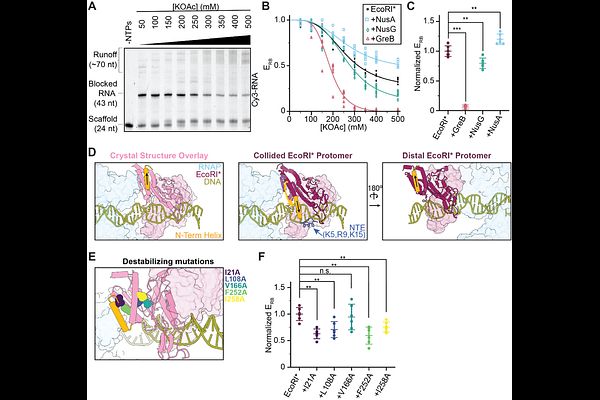
AbstractRNA polymerase (RNAP) must navigate crowded genomic tracks to robustly produce transcripts. DNA-bound proteins act as transcription-impeding roadblocks, which are eventually overcome by RNAPs through unclear mechanisms. Here, we use cryo-electron microscopy to visualize actively transcribing E. coli RNAP upon collision with an inactivated restriction enzyme (EcoRI*) or with another converging RNAP. Both collisions induce RNAP backtracking into an inactive swiveled state. Swiveling is coupled to DNA deformation through a characteristic structural landscape, mediating RNAP pause stabilization across distinct collision geometries. EcoRI* roadblock bypass efficiency is impacted by factors that modulate RNAP swiveling, backtracking rescue, and roadblock stability. In comparison, head-on RNAP-RNAP collisions feature substantial heterogeneity suggestive of sustained dynamics, with variable inter-RNAP distances that are modulated by nascent transcript hairpins which position bidirectional termination sites. By resolving, to our knowledge, novel structures of actively transcribing RNAP undergoing collisions, we provide a mechanistic framework for interpreting mechanical conflicts during transcription.