SemVac: A Semantic Vaccinology Paradigm Powered by LLMs for Antigen Discovery

SemVac: A Semantic Vaccinology Paradigm Powered by LLMs for Antigen Discovery
Zhao, Y.; Shu, Y.; Shu, L.; Lv, P.; Chi, X.; Li, D.; Zhang, J.; Huang, Z.; Ren, H.; Xu, J.; Zai, X.; Chen, W.
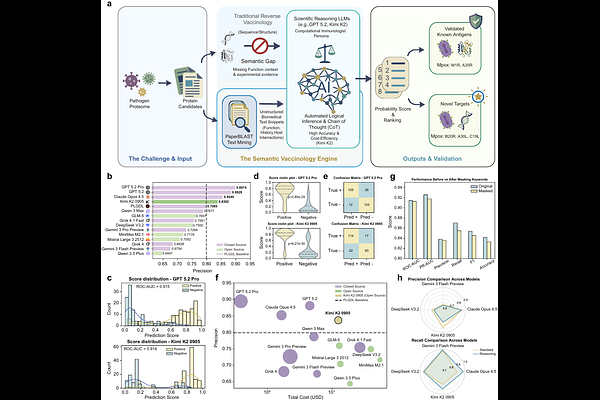
AbstractReverse vaccinology has enabled sequence-based antigen discovery, but it overlooks the rich semantic knowledge embedded in the biomedical literature. Here we establish Semantic Vaccinology (SemVac), a paradigm that leverages large language models (LLMs) to predict protective antigens directly from scientific text. Benchmarking 14 state-of-the-art LLMs on a curated antigen dataset shows that text-reasoning-based approaches match or exceed specialized deep learning models in precision, while offering superior robustness on functionally ambiguous proteins. Intriguingly, explicit reasoning modes (e.g., chain-of-thought) increase recall but consistently reduce precision, revealing an over-reasoning pitfall in biological discovery tasks. Applied to the complete proteome of Mpox virus, SemVac recapitulates known protective antigens and identifies previously unrecognized candidates such as B20R, which our semantic analysis links to immune evasion and structural exposure. This work establishes literature-driven semantic reasoning as a powerful complement to conventional vaccinology, with broad implications for AI-aided scientific discovery.