Optical frequency comb Fourier transform spectroscopy of the CH$_2$$^{79}$Br$^{81}$Br, CH$_2$$^{79}$Br$_2$, and CH$_2$$^{81}$Br$_2$ isotopologues in the 1180-1210 cm$^{-1}$ region

Optical frequency comb Fourier transform spectroscopy of the CH$_2$$^{79}$Br$^{81}$Br, CH$_2$$^{79}$Br$_2$, and CH$_2$$^{81}$Br$_2$ isotopologues in the 1180-1210 cm$^{-1}$ region
Ibrahim Sadiek, Aleksandr A. Balashov, Adrian Hjältén, Michael Rey, Oleg Egorov, Aleksandra Foltynowicz
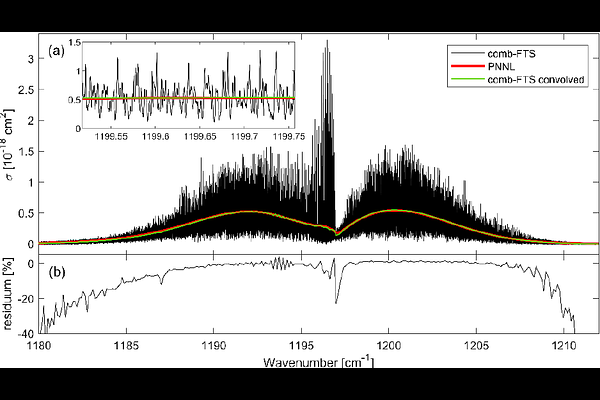
AbstractQuantitative spectroscopic detection of dibromomethane, CH$_2$Br$_2$, for environmental monitoring, workplace safety, and exoplanetary studies is limited by the lack of accurate absorption cross-section data and rigorous spectroscopic models. We report the first high-resolution (6.3 MHz point spacing) absorption cross-section of CH$_2$Br$_2$ in the 1180-1210 cm$^{-1}$ region measured using optical frequency comb Fourier transform spectroscopy. This region is dominated by the strong CH$_2$ wagging ($ν$$_8$) fundamental vibration, which is about 50 times stronger than the fundamental C-H stretch around 3077 cm$^{-1}$. The measurements resolve isotopologue-specific rovibrational features of CH$_2$$^{79}$Br$^{81}$Br, CH$_2$$^{79}$Br$_2$, and CH$_2$$^{81}$Br$_2$, and we assign rovibrational transitions of the $ν$$_8$ fundamental and the overlapping $ν$$_4$+$ν$$_8$-$ν$$_4$ hot bands using two methods. First, an empirical non-linear least square fit implemented in PGOPHER provides high-precision line assignment and spectroscopic constants, including accurate band origins, rotational constants, and quartic centrifugal distortion parameters, for the three isotopologues, covering rotational levels up to K$_a$ = 25 and J = 144, with an average RMS residual of 0.00037 cm$^{-1}$ (11.1 MHz). Compared with previously reported band parameters retrieved from a fit to narrowband (1.78 cm$^{-1}$) supersonically cooled spectra (B. E. Brumfield et al., J. Mol. Spectrosc., 2011, 266, 57-62), our fit provides much improved global agreement between measured and simulated spectra. In parallel, an ab initio-based effective Hamiltonian approach was used to model the complete rovibrational polyads, including weak hot-band transitions and polyad interactions inaccessible to purely empirical fits, and provided the first ab initio-based line intensities of CH$_2$Br$_2$ in the 8 $μ$m spectral region.