A post-selected quantum model of cosmic acceleration

A post-selected quantum model of cosmic acceleration
Dimitris Lionas, Charis Anastopoulos, Konstantinos Gourgouliatos
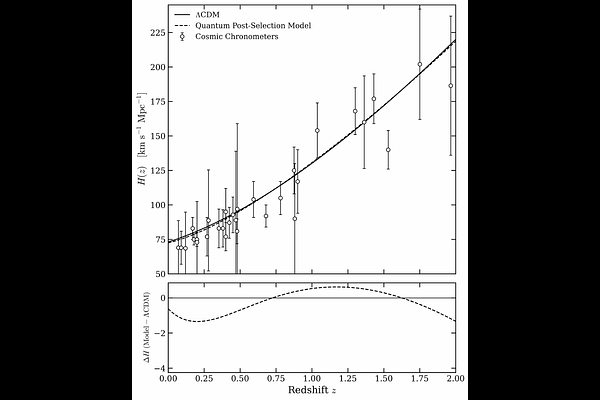
AbstractThe origin of cosmic acceleration remains a central problem in cosmology, commonly attributed to a cosmological constant within the $Λ$CDM model or to dynamical dark energy. Here, we develop an alternative approach in which acceleration emerges from quantum post-selection, a standard feature of quantum theory that is not usually incorporated into cosmological modelling. While quantum theory admits both pre-selected and post-selected ensembles, quantum cosmological models are almost exclusively formulated in terms of initial conditions. Building on previous work on post-selected quasiclassical dynamics, we construct a minimal predictive cosmological model in which post-selection and coarse-graining generate effective late-time acceleration without introducing a cosmological constant, dark energy, or modifications of general relativity. The resulting expansion history is highly constrained theoretically and depends on at most two parameters beyond standard Friedmann evolution. Confrontation with type Ia supernova and cosmic chronometer data yields statistically competitive fits while naturally avoiding the coincidence problem. The model also reproduces the standard radiation- and matter-dominated behaviour at early times and predicts a present-day jerk parameter significantly different from the $Λ$CDM value. These results suggest that cosmic acceleration may arise as a macroscopic quantum cosmological effect rather than from additional cosmological fluids or modified gravitational dynamics.