Regulation of Chlamydia trachomatis infection in the female genital tract by type I and type II interferons

Regulation of Chlamydia trachomatis infection in the female genital tract by type I and type II interferons
He, R.; Wu, Y.; Abdelsalam, A.; Wang, Y.; Fan, H.; Zhong, G.
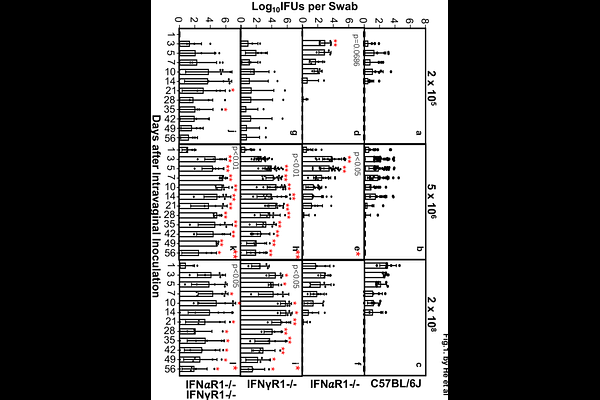
AbstractFollowing an intravaginal inoculation with Chlamydia trachomatis, mice deficient in type I interferon receptor IFNaR1 (IFNaR1-/-) significantly increased the yield of live chlamydiae on days 3 & 5 but reduced it to the level of wild-type mice by day 7, while mice deficient in type II interferon receptor IFNgR1 (IFNgR1-/-) significantly increased the chlamydial yield by day 5 and the increase persisted throughout the remainder of the infection course. These observations reveal a temporal division of labor between type I & II interferons in regulating C. trachomatis infection in the female genital tract. Interestingly, mice deficient in both IFNaR1 & IFNgR1 exhibited higher mortality and shed more chlamydial organisms than IFNgR1-/- mice by week 6, suggesting that IFNaR1 remains critical for inhibiting C. trachomatis at late stages. An anti-IFNR1 antibody blockade significantly increased chlamydial yields in IFNgR1-/- mice, suggesting that the anti-chlamydial activities of type I & II interferon systems are both distinct and overlapping throughout the infection course. Furthermore, the anti-chlamydial activity of type I interferon signaling is localized to the lower vagina, while that of type II interferon signaling is localized to the upper vagina. Thus, we have demonstrated that type I & II interferons function complementarily and synergistically in time and space to control C. trachomatis infection, laying the foundation for further elucidating the mechanisms of IFN regulation of chlamydial infection and for developing interventional and preventive strategies against C. trachomatis in the female genital tract.