ProteinDock: A physics-informed layer to improve protein-protein docking reliability

ProteinDock: A physics-informed layer to improve protein-protein docking reliability
Rajagopal, G.; Spina, S. C.; Bailey, J. S.; Kimmel, B. R.
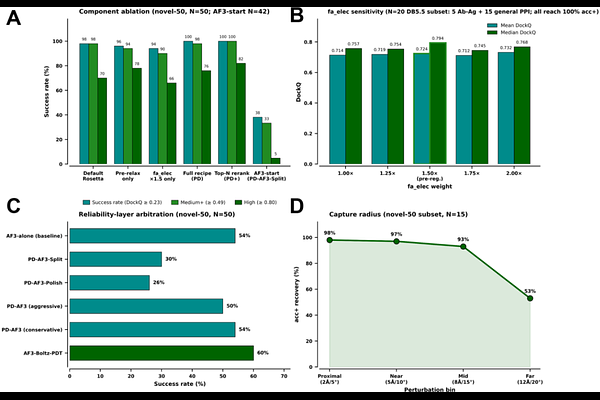
AbstractComputational modeling provides geometric insight into protein-protein interactions without requiring the resources of experimentation. However, reliability can be hindered when modeling proteins with distinctive features, such as antibodies, that use flexible, polar-rich loops to bind antigens. We developed ProteinDock, a physics-based tool that can be used in combination with leading modeling programs to improve the reliability of protein-protein docking; this work provides a case study of antibody-antigen interfaces. ProteinDock was layered onto Rosetta for docking unbound experimentally determined structures, and when evaluated on Docking Benchmark Set 5.5, generated CAPRI acceptable-quality or better for 80.2% of targets, an improvement of 32.8 percentage points over vanilla Rosetta at 47.4% on the same dataset. To improve protein-protein prediction reliability from sequence inputs, we demonstrate that a truncated version of ProteinDock can be used to choose the optimal prediction among outputs from multiple deep learning-based tools. We show that this strategy is a computationally efficient alternative to increasing the seed quantity for deep-learning predictions. A graphical user interface for layering ProteinDock has been created and is available at https://github.com/Kimmel-Lab/proteindock and https://proteindock.com/.