The CLAMP-Linked Invasion Protein (CLIP) plays an essential role in Plasmodium berghei zoites

The CLAMP-Linked Invasion Protein (CLIP) plays an essential role in Plasmodium berghei zoites
Unhale, T.; Das, S.; Marinach, C.; Briquet, S.; Franetich, J.-F.; Boeykens, L.; Sterckx, Y. G.- J.; Silvie, O.
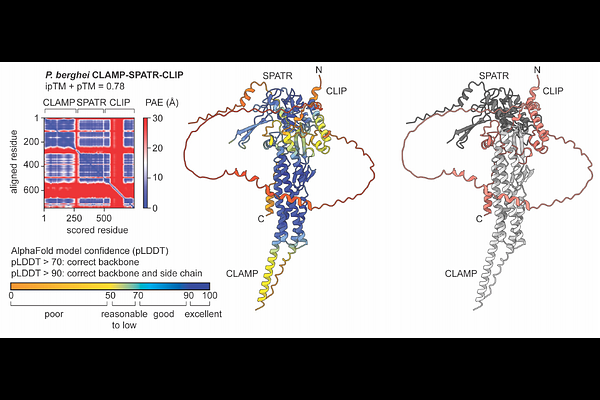
AbstractApicomplexan parasites such as Toxoplasma and Plasmodium spp. rely on the sequential secretion of parasite apical organelles, called micronemes and rhoptries, to invade host cells. The claudin-like apicomplexan microneme protein (CLAMP) is a conserved protein that plays an essential role during host cell invasion in Toxoplasma and Plasmodium zoites. Previous studies have shown that CLAMP is essential in Plasmodium merozoites for erythrocyte invasion and also in sporozoites for the invasion of the mosquito vector salivary glands and of mammalian host hepatocytes. In Toxoplasma gondii tachyzoites, CLAMP forms a complex with two other microneme proteins, the Secreted Protein with an Altered Thrombospondin Repeat (SPATR) and the CLAMP-Linked Invasion Protein (CLIP). Both SPATR and CLIP are also expressed in Plasmodium sporozoites, and downregulation of SPATR impacts sporozoite infectivity in P. berghei. In contrast, the role of CLIP in sporozoites remains unknown. To study the function of CLIP, we used a CRISPR-assisted conditional genome editing strategy based on the dimerisable Cre recombinase in the rodent malaria model parasite P. berghei. Deletion of clip in P. berghei blood stages impaired parasite growth and prevented erythrocyte invasion by merozoites. Upon deletion of clip gene in P. berghei transmission stages, sporozoite development in mosquitoes was not affected, but invasion of the mosquito salivary glands was dramatically reduced. In addition, CLIP-deficient sporozoites were impaired in cell traversal and productive invasion of mammalian hepatocytes, associated with a defect in gliding motility, recapitulating the phenotype of CLAMP-deficient parasites. Collectively, our data demonstrate that CLIP plays an essential role in host cell invasion by P. berghei merozoites and sporozoites, and support a conserved role of the CLAMP-CLIP-SPATR complex in invasive stages of apicomplexan parasites.