A phosphorylation-dependent mechanism controls splice variant-specific S-palmitoylation of cardiac Kv4.3

A phosphorylation-dependent mechanism controls splice variant-specific S-palmitoylation of cardiac Kv4.3
Dickson-Murray, E.; Du, C.; Kuo, C.-W. S.; Gilchrist, R. J.; Mary, S.; Adu, S.; Kämäräinen, O.; Wahdan, A.; Dunning, E.; Jordan, F.; Brown, E.; Houghton, J. W.; Berezina, D.; Lu, J.; Tate, E. W.; Myles, R. C.; Burton, F. L.; Smith, G. L.; Walden, H.; Hancox, J. C.; Fuller, W.
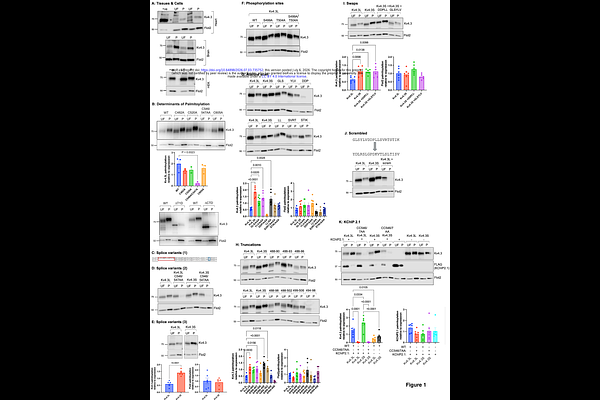
AbstractS-palmitoylation modulates the activity of many cardiac ion channels, yet the upstream signals that control this post-translational modification (PTM) are poorly defined. Here we identify a phosphorylation-dependent mechanism that governs splice variant-specific S-palmitoylation of the potassium channel Kv4.3. Using Acyl-RAC in native tissue and heterologous cells, we map palmitoylation to C546/547 in the intrinsically disordered Kv4.3 C-terminal tail. The short Kv4.3 splice variant Kv4.3S is [~]2.5-3-fold more palmitoylated than the long splice variant Kv4.3L, and systematic mutagenesis localises the dominant inhibitory determinant of Kv4.3 S-palmitoylation to residues 488-498 within the Kv4.3L-specific splice insert. KChIP2.1 promotes accumulation of a post-translationally modified Kv4.3 species that is selectively S-palmitoylated, and nanobody-targeted dephosphorylation removes this species and reduces Kv4.3 S-palmitoylation. Phos-tag electrophoresis and C-terminal truncation mapping identify S538 as the principal phosphorylation site enabling Kv4.3 S-palmitoylation; mutation of S538 markedly reduces formation of the palmitoylation-competent species. TurboID proximity-labelling and biochemical assays indicate that phosphorylation enhances recruitment of Kv4.3 to zDHHC5. Acute kinase inhibition rapidly eliminates phosphorylation but only gradually reduces palmitoylation, revealing temporal uncoupling between these PTMs. Functionally, non-palmitoylatable Kv4.3S exhibits larger peak currents, faster inactivation, and a left-shifted activation curve, consistent with palmitoylation limiting channel function and modulating gating transitions. Together, these findings identify phosphorylation of S538 as a priming modification that licenses Kv4.3 S-palmitoylation at C546/547, explain splice-variant differences in S-palmitoylation, and define a PTM cascade that tunes Kv4.3 channel behaviour.