Expression and Engineering of Conductive Cytochrome Nanowires

Expression and Engineering of Conductive Cytochrome Nanowires
Szmuc, E.; Liu, X.; Reed, M. L.; Damani, V.; Walker, D.; Brilot, A.; Lozano-Zambrano, L.; Yu, G.; Keitz, B. K.; Ellington, A. D.
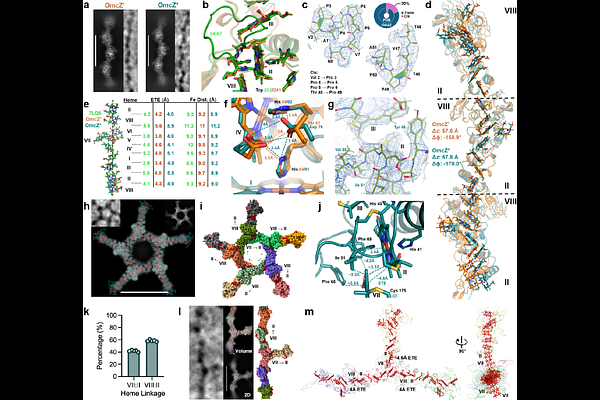
AbstractElectrically conductive protein nanowires produced by metal-reducing bacteria have attracted interest as sustainable electronic materials, but their study and engineering have been limited by difficulties in expression, purification, and genetic manipulation. Here we establish Shewanella oneidensis as a heterologous host for production of Geobacter sulfurreducens OmcZ nanowires and progress a complementary in vitro assembly strategy that yields highly pure nanowire preparations. This platform enabled systematic engineering of OmcZ, revealing extensive tolerance to sequence variation and facilitating the design of enhanced-conductivity variants. Guided by comparative analysis of environmental OmcZ homologs, we generated a chimeric nanowire, OmcZ+, that exhibited a ~3.5-fold increase in bulk conductivity while retaining the overall structure of the parent nanowire. Cryo-electron microscopy revealed unexpected architectural plasticity in OmcZ+ wires, including non-linear dendritic and pentameric assemblies mediated by the solvent-exposed heme VII, suggesting previously unrecognized modes of cytochrome nanowire organization. Incorporation of engineered OmcZ variants into water evaporation-induced electricity generators produced power densities up to ~25.3 W/cm2 and enabled high-performance operation in saline environments, including seawater and human sweat. Together, these results establish a versatile platform for the production, structural analysis, and engineering of cytochrome nanowires, providing a foundation for the development of programmable biological electronic materials.