Altered neuronal start codon stringency favors cap-independent repeat-associated non-AUG translation

Altered neuronal start codon stringency favors cap-independent repeat-associated non-AUG translation
Wieland, C. M.; Wright, S.; Willey, S.; Purwar, I.; Grudzein, S. J.; Laimon, E.; Asher, M. J.; Isaacs, A.; Garner, A. L.; Todd, P.
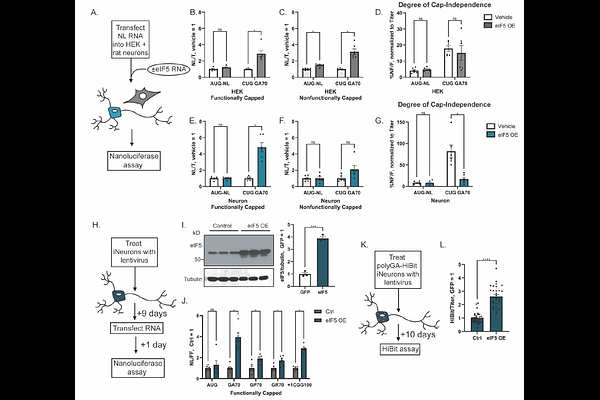
AbstractIntronic GGGGCC repeat expansions in C9orf72 cause amyotrophic lateral sclerosis (ALS) and frontotemporal dementia (FTD). This expansion supports a non-canonical form of translational initiation known as repeat-associated non-AUG (RAN) translation to produce toxic dipeptide repeat proteins that contribute to neurodegeneration. Here, we find that the efficiency of RAN translation and its dependency on the 5' 7-methylguanosine mRNA cap are variable across cell types, with both rodent neurons and human iNeurons favoring cap-independent RAN translation from two distinct repeats (CGG and GGGGCC) across multiple reading frames. Treatment with an eIF4E inhibitor that blocks global cap-dependent translation enhances RAN translation specifically in neurons. Intriguingly, cap-independent RAN translation exhibits less reliance on near-cognate codons for initiation than cap-dependent RAN translation. This finding led us to identify a surprising global increase in start codon stringency in neurons as a contributor to the relatively higher cap-independent RAN translation in this cell type. This effect correlates with a cytoplasmic redistribution of eIF1 in neurons and is reversed with neuronal overexpression of the eukaryotic initiation factor eIF5, which relaxes start codon stringency and selectively enhances cap-dependent RAN translation. Taken together, these findings reveal several neuron-specific features of translational regulation that favor cap-independent RAN translation with implications for nucleotide repeat expansion disorder pathogenesis and neuronal translational regulation.