Biomechanics of chemically treated hair for continuous 1D strands

Biomechanics of chemically treated hair for continuous 1D strands
Podili, A.; Meer, A.; Mody, J.; Gosnell, D.; Vasile, A.; Alshansky, D.; de Guzman, R. C.
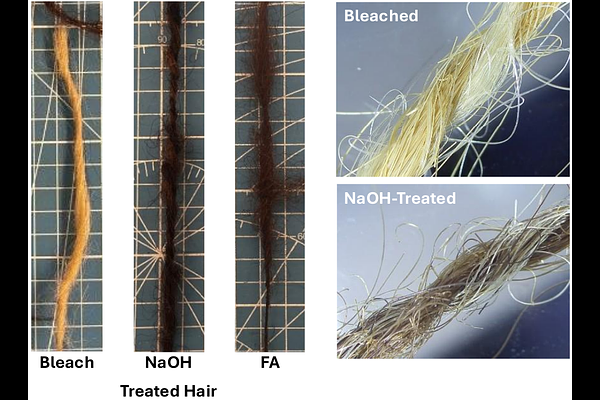
AbstractHuman hair is a keratin-based fiber with mechanical properties relevant to load-bearing biomaterials; however, its smooth cuticle limits fiber-fiber cohesion during textile-style processing. This study examines how controlled chemical decuticularization influences surface morphology and tensile behavior of intact human hair assembled into continuous one-dimensional (1D) strands. Hair was treated with oxidative bleach, sodium hydroxide (NaOH), or formic acid (FA), carded, and spun using a standardized protocol. SEM imaging showed treatment-dependent surface disruption, from minimal cuticle modification (bleach) to partial scale lifting (NaOH) and extensive cuticle removal (FA). Tensile testing revealed significant differences in Young's modulus, ultimate tensile strength (UTS), and elongation at break (EAB) across treatments (ANOVA, p < 0.05). NaOH-treated strands exhibited the highest modulus (207 MPa), UTS (34 MPa), and moderate extensibility (28%), whereas bleach- and FA-treated strands showed reduced stiffness and strength. Compared with reference yarns, NaOH-treated strands approached the stiffness of wool and retained greater extensibility than cotton. These findings support a processing window in which partial decuticularization enhances fiber cohesion while preserving mechanical integrity. The resulting 1D strands provide a potential building block for woven biomesh structures, motivating further evaluation of durability, cyclic behavior, multi-ply configurations, and computational modeling.