Repeated Gravitational-Wave Lensing from Binary Black Holes on Eccentric and Precessing Orbits around Spinning Supermassive Black Holes

Repeated Gravitational-Wave Lensing from Binary Black Holes on Eccentric and Precessing Orbits around Spinning Supermassive Black Holes
Jie Wu, Mengfei Sun, Jin Li, Zhoujian Cao
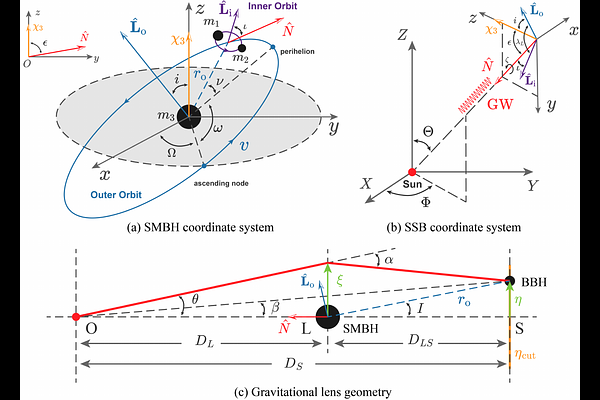
AbstractGravitational waves (GWs) from a stellar-mass binary black hole (BBH) orbiting a supermassive black hole (SMBH) can experience repeated gravitational lensing as the BBH passes behind the SMBH. Our previous studies of orbit-induced GW modulation motivate this investigation of repeated lensing in evolving hierarchical triple systems. We investigate how eccentricity, inclination, and relativistic precession of the outer orbit affect successive lensing events and parameter inference. The outer orbit follows post-Newtonian dynamics, and the inspiral waveform includes moving-source effects and de Sitter precession. An event-local point-mass lensing model tracks the changing source--lens alignment and GW frequency. For a one-year LISA observation, we examine lensing-event identification, Fisher-matrix estimates of parameter uncertainties, and waveform residuals when lensing is omitted. Our results show that outer-orbit evolution changes the timing and amplification of successive lensing events and can bring initially unfavorable configurations into the lensing region. A fixed circular, nonprecessing approximation misses all lensing events for a substantial fraction of the selected lensed systems. The median fractional reductions in uncertainty are largest for the outer-orbit inclination and SMBH spin. For some systems above the adopted detection threshold, lensing-induced waveform differences persist after local adjustments to the parameters of the unlensed model. Repeated lensing can thus provide complementary constraints on SMBH properties and outer-orbit geometry in LISA observations of hierarchical BBHs.