A stereotyped glial attachment determines the morphology and function of neuronal cilia

A stereotyped glial attachment determines the morphology and function of neuronal cilia
Wexler, L. R.; Griffin, B.; Dutta, P.; Sengupta, P.; Kolotuev, I.; Ringstad, N.; Heiman, M. G.
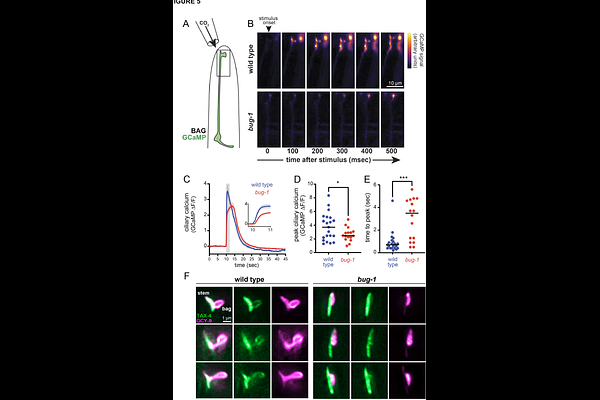
AbstractPrimary cilia are signaling hubs that influence nearly every aspect of cell physiology. Neuronal primary cilia were recently discovered to interact with glia in the mammalian brain, but how cilia-glia attachments form and what roles they play remain unknown. Here, we find that two C. elegans sensory neurons (URX and BAG) use their primary cilia to attach to a specific glial partner (ILsoL). Through a genetic screen, we find that cilia-glia attachment requires BUG-1, a secreted protein with conserved cell adhesion domains that localizes to the cilia-glia attachment site. In the absence of BUG-1, neuronal cilia are present but fail to attach to the glial cell. We find that loss of cilia-glia attachment alters cilia morphology and disrupts stimulus-evoked calcium dynamics in cilia. We propose that primary cilia not only act as antennae for long-range cell communication, but also form close-range cell attachments that modulate cell signaling.