Two ancient nuclear lineages and divergent reproductive strategies drive global success of the wheat stripe rust pathogen

Two ancient nuclear lineages and divergent reproductive strategies drive global success of the wheat stripe rust pathogen
Wang, J.; Xu, Y.; Li, Z.; Zhan, G.; Zhan, J.; Kang, Z.; Zhao, J.
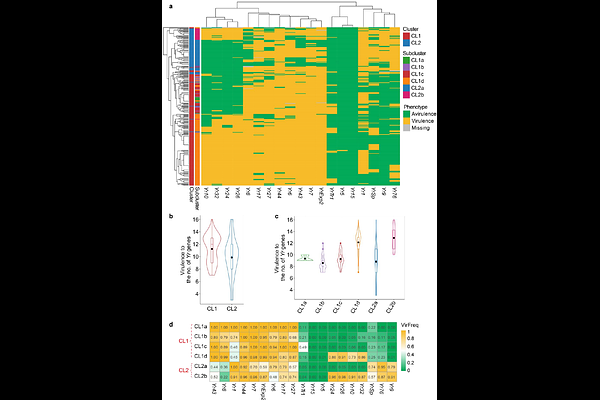
AbstractUnderstanding the mechanisms for generating and maintaining plant pathogen genetic diversity is essential for predicting disease emergence and safeguarding the food supply. Here, using population-genomic analyses of 507 global isolates of the wheat stripe rust fungus Puccinia striiformis f. sp. tritici, we uncover two nuclear lineages that diverged before modern agriculture and reinforced during wheat domestication. Distinct lineage combinations underpin three major global populations: two predominantly sympatric, homozygous lineages (nuclA-nuclA and nuclB-nuclB) and a globally dominant heterokaryotic lineage (nuclA-nuclB) of hybrid origin. This hybrid population evolves largely clonally, accompanied by recurrent somatic nuclear exchange. Identical virulence traits can arise independently via somatic nuclear exchange in clonal populations or through sexual recombination in recombining populations, revealing convergent evolutionary routes to adaptation. Together, our results provide a transformative nuclear-level perspective linking deep evolutionary history and reproductive strategy to the global success of cereal rust fungi.